Tuesday, November 7, 2006

Core Samples from the World

Along China's Western Edge

Note: This is the first in a series, core samples from the world. Not meant to serve as travel guides, much less as any sort of informed historical narrative of regions with which I have, often, only cursory acquaintance, these prose passages are personal, particular, often peculiar relations of encounter between poet, poetry, and place. They are the notes of a wayfarer, and of the kind prone to missing the festival in the square because he was squatting to watch a worm fight in an alley.


At Chicago’s O’Hare, boarding the flight to China for a two-part international poetry festival that begins in Beijing and then moves to the far western Xinjiang Autonomous Region. When the steward takes my ticket, I notice fluorescent orange earplugs dangling from a string around his neck. Are my first instincts always self-protective and proprietary that I wonder, What does he need them for, and where are mine?

* * *


At the Xi Xuan Hotel in Beijing, we take the stairs from the lobby down to the basement conference area. The ante-room is opaque with smoke, otherwordly, like a waiting room in Hades. Local poets furiously lighting up before the panel begins. The guidebooks suggest bringing presents to a Chinese host or business partner, and good quality cigarettes, Marlboros in particular, are recommended. The first time I visited China, I brought them. But it felt complicated, from my perspective, coming from a country where smoking is banned from most public spaces, where the dangers are so specifically categorized, to express personal fondness with a carton of tar and methane. On the other hand, as I will find, the Chinese have no qualms about trying to embalm me with compulsory shots of bai jiu and endless toasts. It’s curious that bonding is so often a kind of coalitionary self-destruction.

In the conference room, we take our seats, the hosts are thanked, the press identified, the writers, thirty Chinese poets and a dozen international poets, introduced by Xi Chuan, our bilingual host, poet, and thinker, a man at ease in his body. He looks down when he talks, unconcerned about eye contact, and periodically swipes hair from his eyes. During the long passages in Chinese, I begin to see that the gestures of his hands are also organs of language.
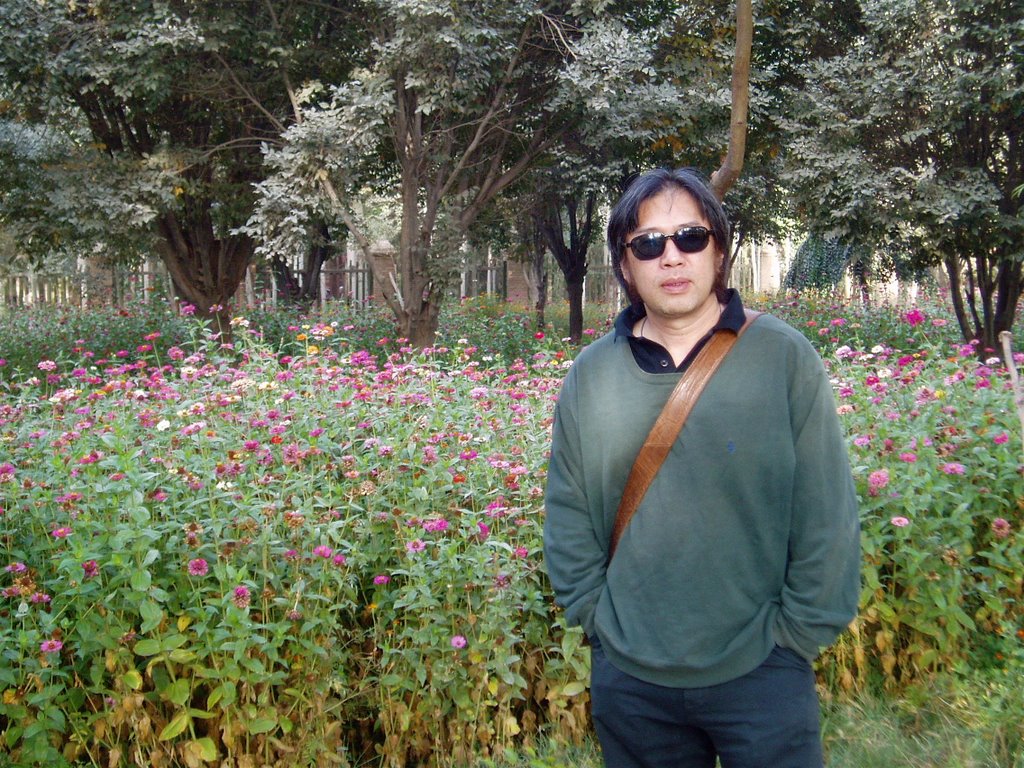


Xi Chuan
* * *

Now the roundabout of first comments. German poet and translator Wolfgang Kubin credits Ezra Pound’s translations for turning him, forty years ago, toward China. The mic goes to Scottish poet William Herbert, to several Chinese poets, to Kazuko Shiraishi, to French poet Andre Veltner. Tang Xiaodu, the other conference organizer, paraphrases Adonis: When I am abroad, I am most at home. Shimizu Tetsuo, from Tokyo, notes that unlike most poetry, haiku is the product of group endeavor. (I wonder if writing in a public space, in a café, for instance, is a Western variation. We tune-in the energy of a public setting, but without relinquishing control?)


Yang Lian
* * *

Ex-patriot Chinese poet (living in London) Yang Lian quotes Tu Yuan’s “Question to Heaven” and identifies poetic endeavor as a questioning. Then he says, “If it weren’t for the substance of poetry, we wouldn’t be worthy of our own experience.” Emran Salahi, who will die of a heart attack two days after the conference, Salahi, the sweet-natured poet from Iraq, speaking Persian, says, in response to my question about traditional Persian forms, that his own poetry is quite modern, unrestricted by traditional conventions. (Later, I will see that what he means by this is that he writes in free verse.) The famous calligrapher and poet Ouyang Jianghe notes “Every mature poet has his particular vocabulary.” Che Qianzi, one of the younger, experimental Beijing poets, responds with a spontaneous poem, “part haiku,” which plays on the names of the two Japanese poets, Kazuko Shiraishi and Tetsuo Shimizu. The conference organizers, Tang Xiaodu and Xi Chuan, offer summarizing observations on the unsettled state of contemporary Chinese poetry in a culture shifting at warp speed. We don’t want to go backward, Xi Chuan observes, but ahead of us, the ways fork in innumerable directions and each is hemmed with liabilities and responsibilities.

Given the gravity of the discussion, it seems the panelists mean to map out a future for Chinese poetry, as though it might be prescribed, tagged with a five year plan. But I am merely inept at reading the forms of discussion here, much less the subtleties. What I take as evident bounces away from me. I begin to notice tensions, faces shaking no, one translator interrupting another to retranslate a comment into English. The topic, Where is Chinese poetry going in the age of globalization, is enormous and of course the answer will be found in poems, not panels, so I try not just to listen, but to listen into. What else is being asked, what is at stake for them?


Tang Xiaodu
* * *

Five airless hours after the first conference panel begins, we swarm back through the ante-room’s cigarette nebulae, and back up the stairs to the hotel restaurant where, exhausted, we plop down at round tables and aim our chopsticks at the endlessly various plates and bowls circling on the Lazy Susan.

* * *

Stone Boat at the Summer Palace Lake


* * *
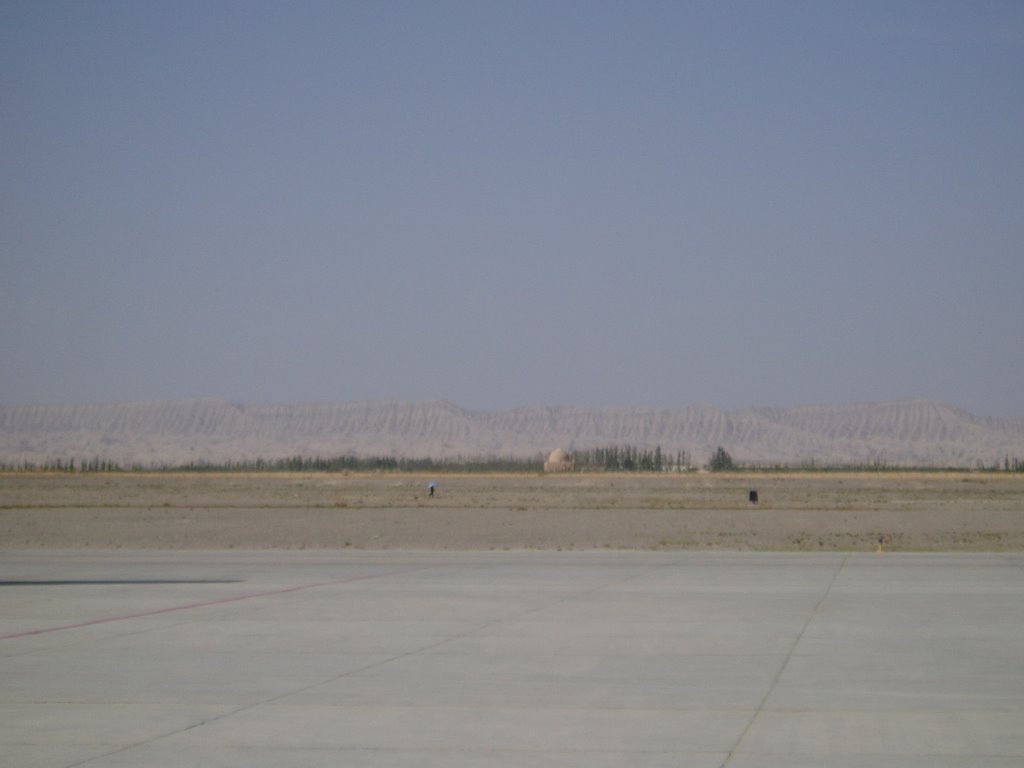

Kashgar Airport


* * *


At the Poet’s Tomb


* * *


Evening Prayer, Mosque Minaret


* * *
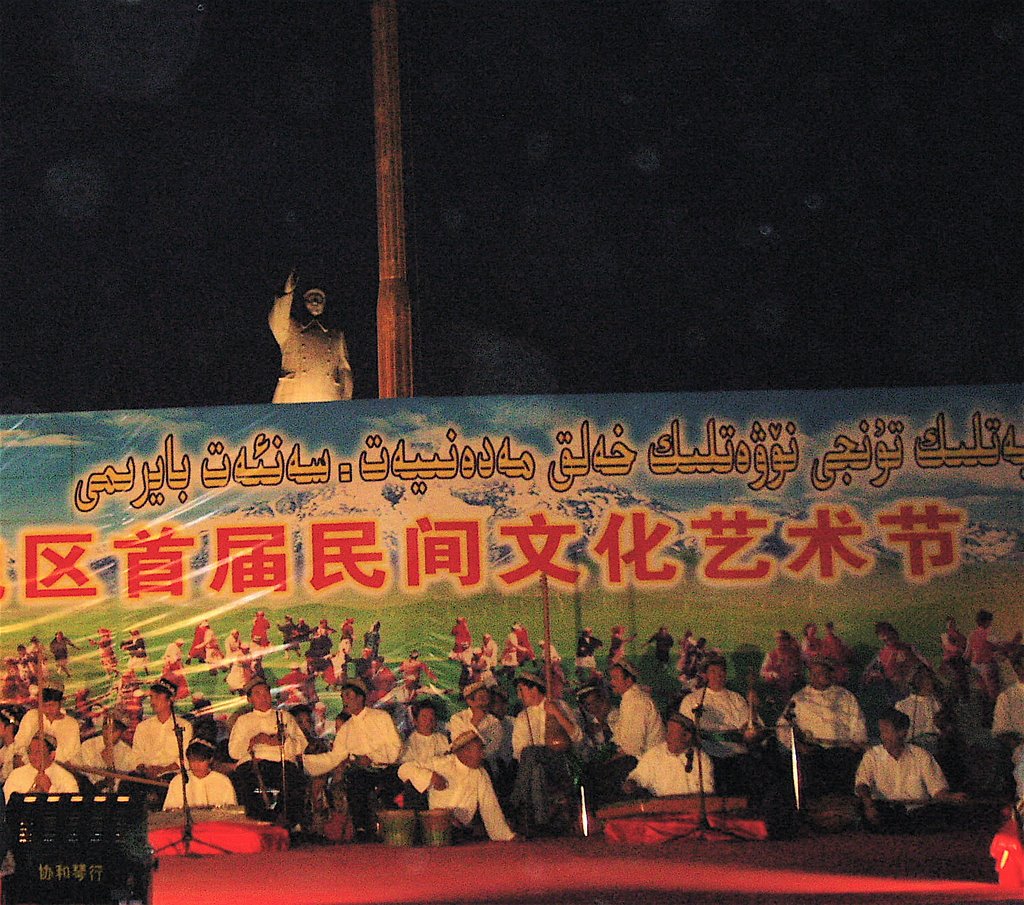

Evening Performance of Traditional Musicians, Statue of Mao Presiding


* * *
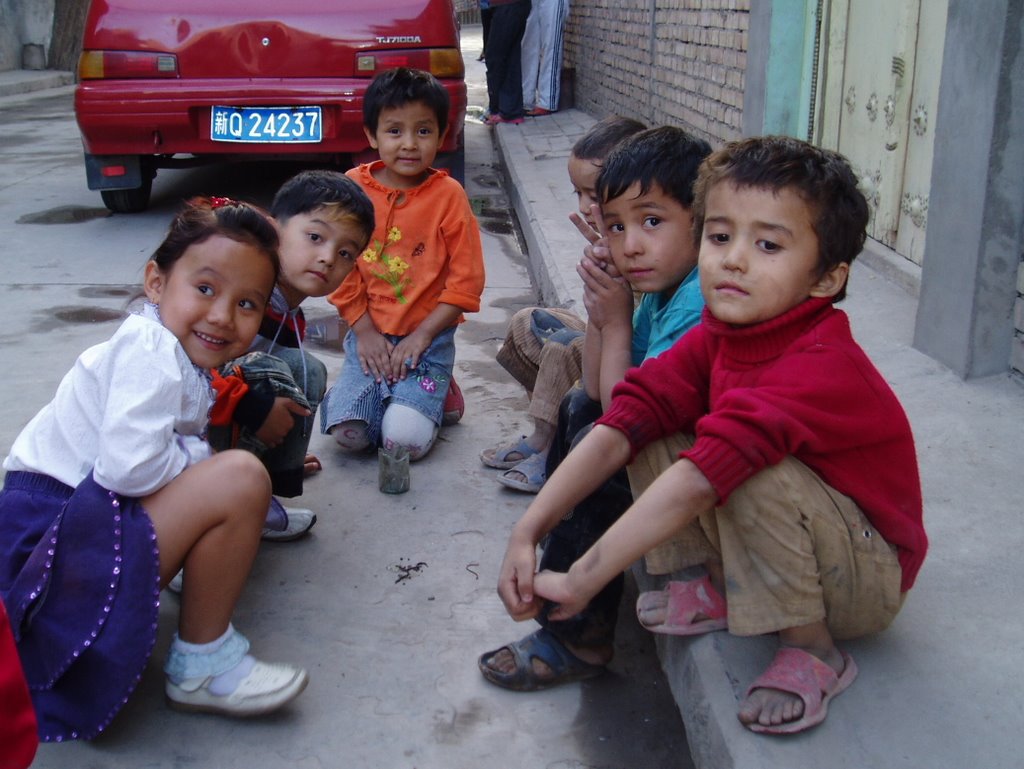

Worm Fight


* * *


Cemetery in the Autonomous Region


* * *


Mountains in the Autonomous Region


* * *
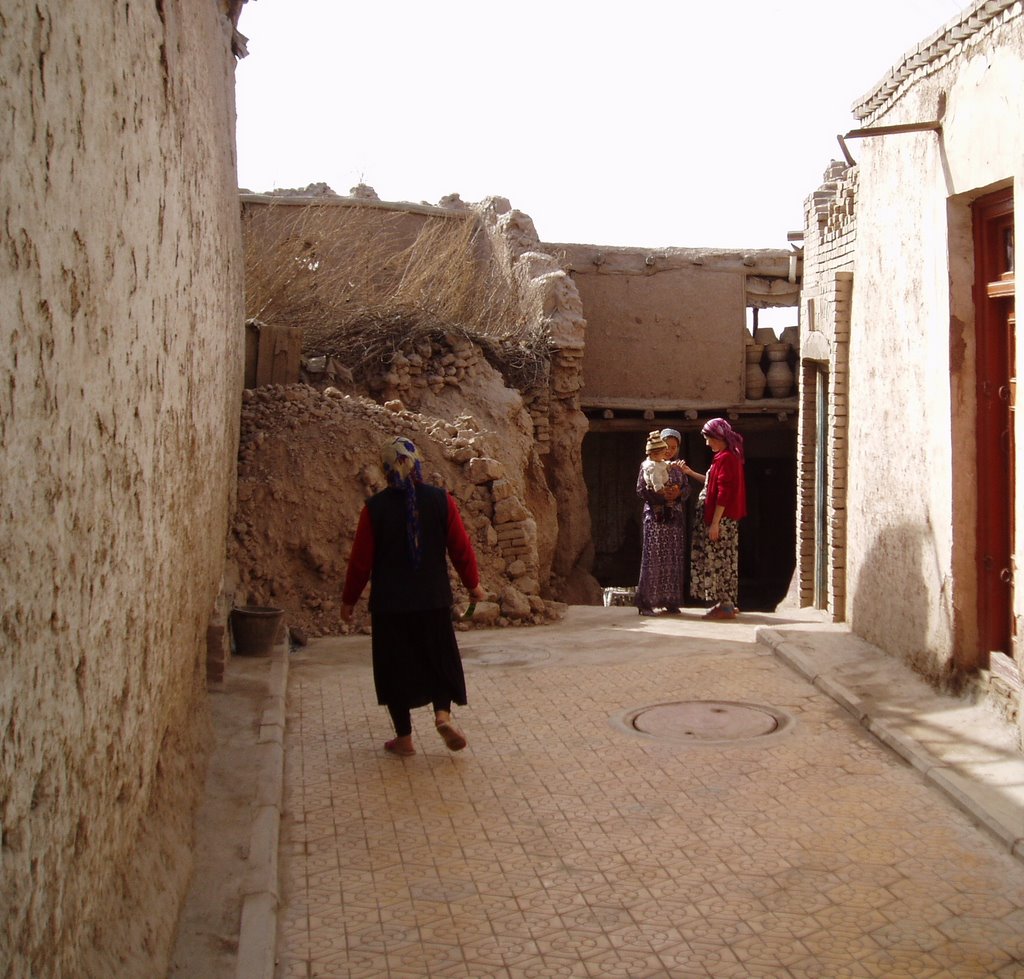
The Old City


* * *
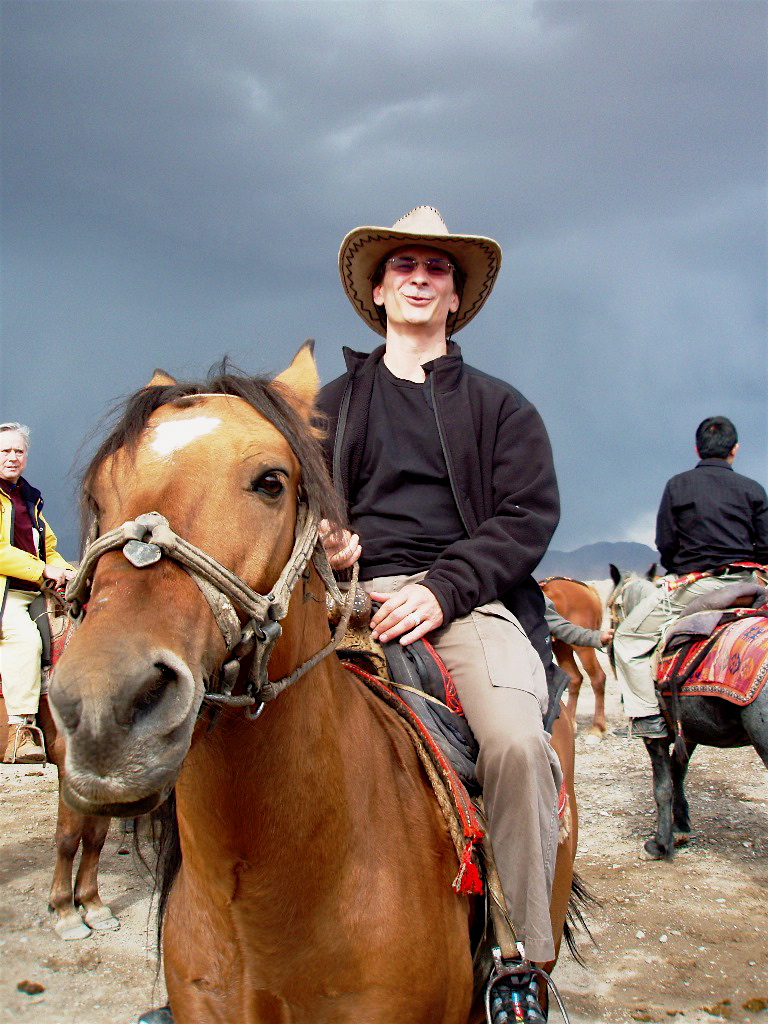

Author before the Storm


* * *

Where IS Chinese poetry going in the age of globalization?

I’m not so presumptuous that I would say. But certainly it is going to America, among other places. Here is a glimpse of some of what I see going on.

Bei Dao, a figure nothing like T. S. Eliot or William Faulkner, has achieved something of their status in China. Whether it serves as a model or a point of departure, his work must be taken into account by any serious Chinese poet. As Flannery O’Connor said of Southern writers in relation to Faulkner, "Nobody wants his mule and wagon stalled on the same track the Dixie Limited is roaring down." Bei Dao’s poems, translated powerfully by Eliot Weinberger and published by New Directions, don’t remind you of freight trains, but they carry a markedly evocative force. Here is an uncollected translation of one of Bei Dao’s recent poems that I heard him read in Chile, the audience enthusiastically swarming him afterwards.

Ramallah

In Ramallah the ancients play chess in the starry sky
the endgame flickers
a bird locked in a clock
jumps out to tell the time

in Ramallah
the sun climbs over the wall like an old man
and goes through the market
throwing mirror light on
a rusted copper plate

in Ramallah
gods drink water from earthen jars
a bow asks a string for directions
a boy sets out to inherit the ocean
from the edge of the sky

in Ramallah

seeds sown along the high noon

death blossoms outside my window

resisting, the tree takes on a hurricane's

violent original shape


Xi Chuan, who is more than a decade younger than Bei Dao, marks the beginning of a “new generation.” A critic as well as a poet, Xi Chuan is one of the poets most articulately involved in questioning the trajectory of contemporary Chinese poetry. Several Americans have been interested in translating his work, but almost nothing is available here.

Wang Ping, has lived in the U.S. for more than twenty years. Associated early on with Lewis Warsh and the 1980’s lower east side New York poetry scene, she helped to translate and call attention to the work of her contemporaries and, in addition to writing criticism and fiction, writes poetry. Her book The Magic Whip mixes prose and poetry, a formal equivalent of the themes with which the book is concerned.

Zhang Er, also associated with the New York poetry scene, with Leonard Schwartz and Talisman House, has seen her work translated by a panoply of good American poets, and her first major book in English, Verses on Bird, was published recently by the excellent Zephyr Press which also publishes Duo Duo, a riveting and influential poet who trained, not incidentally to his poetry, as an opera tenor.

Zhang Er has edited an anthology of Chinese poets, including the work of younger innovative poets like Mo Fei and Cao Shuying. It will, no doubt, play a major role in creating an audience for innovative Chinese poetries. In her introduction, she notes, with reference to the younger Chinese poets she includes, that: “Their work is complicated, filled with conflicted thoughts and emotions, which demand various writing strategies, as well as a wide range of vocabularies and forms. Their aesthetic stand, if I can speak for them, is in stark contrast with the conventional Western view of Chinese poetry's ‘pure, natural, clean, concise imagism.’ For sure, they use plenty of images, but they use them in their messy and maximum way, along with many other strategies. Their view of the Chinese language, as reflected by these writings in Chinese characters, is holistic: the images of things themselves, the human perception and understanding of things, and the human voices that name them. At the root of the Chinese writing system (the characters) live things themselves, not just the images kept as records but the acceptance of things themselves, things that do not need explanation or even to have a fixed articulated name. Human perspective, reasoning and voice are somehow treated in the Chinese language as secondary or even arbitrary.”

One of the edgiest of the younger Beijing poets is Che Qianzi, who has been impossibly but aptly translated by Yunte Huang. Huang, who is known in China principally for his translations into Chinese of Ezra Pound’s Pisan Cantos, is better known in the U.S. for his critical work and for his own poetry, notably the high-energy Cribs, published by Tinfish Press.

The brilliant, exuberant Hu Xudong, who teaches World Literature at Peking University and speaks of a plural inner self, writes a high speed, macaronic poetry that incorporates provincial dialects, advertisements, classical references, and surrealism. His most recent book awaiting translation into English is titled When Love is a Spreading Disease.


Hu Xudong (right) with Zhou Shu
* * *

Zhaiyong Ming, of Chengdu, is one of the most widely admired poets in China. Her early work is notable for its dense ambiguity, for its shifting fields of association and its dark intimations. Her more recent poems are limpid and precise, easier to translate. But Like Xi Chuan’s, Zhaiyong Ming’s considerable accomplishment as a Chinese writer has yet to be brought over into English in a collection that makes clear why she is so highly regarded.

In Shanghai, the poet Wang Yin makes his living as a photographer and writes the most vividly imagistic poems-- "one raindrop and then another/ on a power line"-- that I encountered in China. The images are made more complex by the lineation, which breaks through the framing syntax, but the emotional registers of the poems are clear and intense.


Wang Yin
* * *

Living in Providence, RI, Xue Di’s translated work has been well-received in the U.S. (even inciting comparisons with Rimbaud). And London-based Yang Lian’s ambitious, often book-length poems have been widely translated in Europe but are most readily available to Americans through Green Integer’s Yi and through Blood Axe’s Concentric Circles. Zhou Zhan, whose scholarly work has focused on translation and contemporary Chinese poetry, has a widening fan base for her own work which has been appearing in translation in England and the U.S. I’ll close this essay with a poem of hers from the series Death in Childhood. It is translated by Susan M. Schultz and Jennifer Feeley.

Debtor

He used his sign-off to repay
money owed in this world of dust the rope
borrowed in perpetual debt
as though everyone alive became his creditor
secretly condemning him all solutions to follow the one
child witnessing death for the first time
in constant fear of life’s debt
death is itself not frightening it’s only prolonged
a person’s body posts his shadow
on memory’s earthen wall
takes an old man’s voice while he lives
shutting it behind the wall . . . she startles
awake from her dreams hearing the cadence of his speech
his chatter about the weather about bees
and summer’s mosquitoes (children can’t fathom
boredom) using boredom’s quickening, life
arrives appearances swiftly change—now he’s dead
he’ll never again grow old his body slender
at the intersection of dreams arousing her adult desires


Zhou Zhan
* * *

Thursday, November 2, 2006

SOME NOTES ON THE HENDRIX-MURPHY FOUNDATION PROGRAM CATULLUS TRANSLATION WORKSHOP AT HENDRIX COLLEGE

Many might find visiting a college campus and spending a Friday and Saturday in colloquium with students and professors run of the mill. When Hendrix College and their Classics professor, Dr. Rebecca Resinski, provided me a small grant to visit with their Classics students on October 27th and 28th to work on translations of Catullus I felt blessed.

While I regularly travel the world on business, rarely do my artistic pursuits provide entrée to such opportunities. To wake Friday morning in the beautiful Hulen Hall on the subtly sublime Hendrix College affected me deeply. I looked over my notes on translation—a few scattered thoughts I would share with students.

I looked over the translations I would read on Saturday morning there in Hulen Hall during colloquium. I would be reading translations of Catullus Dr. Resinski informed me had already been published at Lucas Klein’s journal Cipher. See: http://www.cipherjournal.com/html/koehn.html.

I do wish Lucas would communicate with me as I have no idea when or if he ran these translations. I sent them in July and was informed by Dr. Resinski about their appearance at Cipher. I wish I knew more.

I closed my morning with a browse through the student translations of Catullus’ 1, 5, 7, 8, 12, 13, 22, 24, 41, 43, 48, 50, 51, 69, 70, and 99. The student translations struck me as accomplished—but even more impressively they had that feel of things made not by a process but of things made by the human hand. Their translations possessed a texture like hand-woven cloth or hand made paper--some times rough, sometimes delicate, but always imbued with a quality of concentration and diligence that only comes as a result of care.

Deeply impressed with the students and their translations, I felt my worry about having lost Catullus to the classicists at the expense of the modern poet misplaced. Part of me began to think, only students of such skill deserve Catullus. The intellectually lazy and generally muddled minds of most contemporary poets don’t possess the nuance of imagination let alone language to appreciate what Catullus offers.

Against my better judgment I shared with the students, what I think might be a mistaken thesis. My proposition that the modern poet need reclaim Catullus. This may actually ruin him. The students I worked with possess such detail-oriented Latin skills in combination with sweeping imaginations—these personalities in combination with the inspired guidance of Dr. Resinski—suggests the worst thing that could happen to Catullus is that he be treated less by these diligent minds than others.

When I think of how coarse a fair provided by most poets minds one hesitates. Do I really want to bring Catullus fully forward into the contemporary consciousness? He will be mistreated and misunderstood: pilloried and mimeographed by the sad undoings of the trade’s imitators. Translations that might salvage Catullus from the scrap heap will find their way into the ugliest of verse. How many forgettable poems will begin with some subtly wrought line of Catullus’ 51. How many books will quote the unbearable beauty of the line, “lumina nocte,” prefacing the worst of songs?

So here I share my misguided notes on reclaiming Catullus followed by a few paragraphs on Dutiful Translation. It is with the deepest of gratitude towards Hendrix College and Dr. Resinski that I post these notes. One evening Dr. Resinski and I meandered our way through a neighboring wood neither lost nor heading particularly anywhere--her gift is that joy of process so dearly lacking in most educators. Even in our brief, mindful glide through the Arkansas dusk one senses, with her, the experience is its own reward.

Without the opportunity to work with Hendrix College’s genuinely impressive Classics students I would not force myself to think through problems of translation—however failingly—as I have done here.

RECLAIMING CATULLUS (Revised Notes)

“The original is unfaithful to the translation.”

Jorge Luis Borges, On Henley's translation of Beckford's Vathek, 1943,

The ‘availability’ of Catullus, is both a challenge and an opportunity. My original thesis in translating Catullus was that Catullus, the pleasure of Catullus, has been subsumed by the classicists and the philologists. Prof. Rebecca Resinski of Hendrix College corrected my course here. She took exception because I made it sound “like classicists and philologists have swallowed Catullus up and have been keeping him from others.” There may be some truth to that—but I clearly overstated.

Rebecca pointed out that the burden of ownership rests with the contemporary poet. She added that “Catullus is there for the taking; why haven't more of them taken him up? Wariness about things old and canonical? Changing curricula de-privileging Latin? Habits of reading that lead many contemporary poets to read mostly other contemporary (or relatively recent) poets? Some of all of these things, and more?”

She even added that classicists take pleasure in folks like myself taking an interest in their kind of work. As she says, “we are enthusiastic about non-classical responses to ancient authors. It's the relief of seeing something that we love have a life outside our academic circle.” So Rebecca and I have agreed that my thesis ought to be amended to suggest the pleasure of Catullus has not been “subsumed by” but rather “abandoned to” the classicists and philologists! Semantics aside, what is real, is that Catullus has all but disappeared from the hands, mouths, and ears of contemporary poets.

As an example of where this loss is not the case, take Classical Chinese Poetry. The poems from Li Po to Du Fu live in the minds, hearts, and hands of contemporary poets because poet translators have put them there. I myself translate these poems.

Translated, re-interpreted, and re-translated--these Classical Chinese Poems live not only in the Chinese department of the university but in the popular life of the contemporary poet. Catullus, the most modern and sensitive of all the Latin poets, has not benefited from such care--at least not in the last thirty years.

And Catullus has proven he needs to be re-invented every twenty years or so. Consider why there have been thirty different well-read (and as many lesser read) translations of Catullus into English since 1600. Whether Lamb's metrical versions of 1887 or Copley's hip versions from 1966 each age re-invents Catullus for its own palate.

Catullus appears to elude Frost's suggestion that "poetry is what is lost in translation." Despite the misery of translators through the ages, the genius of Catullus emerges and then re-emerges throughout literary history. Catullus seems irrepressible in any age. Yet in our own modern era he still seems trapped in the turn of the 19th century--unexplored in our own.

As Kinnell asserts in his preface to his translations of Villon, “In these very greatest poems we sometimes find the opposite phenomenon to what Frost described. We find to our amazement that poetry also has an irrepressible translatability. Their wholeness or grace, their vision, sense of life, are so urgent and overriding that the surpassingly great poems seem almost (but not quite) to transcend their words. With them, the ‘poetry,’ even if very little of it, is precisely what does come through in translation.”

In my opinion the most recent translations have failed to help Catullus make this leap from the history text to the contemporary quill. My translations of Catullus focus on reclaiming Catullus for the American poet of the 21st century. Some of the simple techniques I employ include dropping traditional Latin names whenever possible, and modernizing vernacular to match the spirit of Catullus in our era.

Other decisions I have made when translating Catullus adhere, again, to Kinnell's approach as when he says, “Translation is a possible art and a necessary one, and I think that we do really want to know, insofar as it's possible, what Dante and others in the past thought and felt. The translator should try to understand how they thought and felt and try to completely suppress himself, or to put it the other way around, try to flow into that person he's translating and do it faithfully."

But this does not mean adopting false tone nor trying to assert meters in English that can only exist in the other tongue. Kinnell is cutting to the quick of why poets translate: we want to inhabit the lives and words of the poets we admire and, in tongues not our own, translation is that only vessel.

I rarely set off in a serial manner telling myself, “today I will translate poems 1- 5. I have had to find very personal motivations for exploring one poem of Catullus or another. Usually I find my emotional, psychic, and spiritual self caught in the atmosphere of the tropes at work in a particular poem of Catullus and I use that feeling to situate myself in relation to a specific poem. For example, I have a long history with 32. 32 brought me to Catullus when I picked up the Bobbs Merill/Roy Swanson translation out of an old textbook box in my high school. 20 years later, 32 became the first poem of Catullus I would translate. I used that history when working on 32 though none of that “motivation” appears in the final version.

I used my relationship with my mentor, the Professor of Classics at Hendrix College, to serve as my proxy for the relationship between Catullus and Ipsithilla the high-class prostitute of poem 32. By mentioning this I mean no insult to Rebecca—in fact I assume she sees the humor and poetic rational of it, just as Catullus might. In this way I stumbled my way into the poem and found a tack that provided creative energy to drive the resulting translation. In fact I’ve used my relationship and my experiences with 1. my wife; 2. my friend and fellow poet Sholeh Wolpe, and 3. my friend and fellow poet Scott Brennan to “get at” the aesthetic nerve when translating this poem or that of Catullus.

I am not one who thinks any one translation best—even more so, I think no one translator gets every poem even reasonably well. So I have found best versions across ages and translators. I think this is what eludes most modern writers and, especially, editors. They somehow falsely believe that version x or y or collection z have somehow exhausted Catullus—when in fact if you read versions a-z, I think you might come up with the exact opposite conclusion.

In one exercise I took many, many different versions of Catullus 32, and assembled them into an inventory and separated them from their publication dates. I then created a worksheet for myself and other poets to match the age with the version of 32.

Poets I exposed the "quiz" to, admittedly with almost no intrinsic knowledge of Catullus, could not accurately pair the age to the version. Even more pleasant, the poets reacted lovingly to several different versions of the same poem--adoring many rather than privileging one. Some versions they thought very modern were quite antique.

They were surprised how engaging so many different versions of the very same poem could be—voila the magic of Catullus. The one complaint (or one might say difficulty) the poets had was that none of the versions seemed distinctively contemporary—they all had the stink of the “pen of literature” about them—to steal from Milosz.

Sugeng Hariyanto quotes Andre Lafevere from Bassnett-McGuire, 1980: 81-82 noting “seven methods adopted by English translators in translating Catullus's poems: phonemic translation, literal translation, metrical translation, verse-to-prose translation, rhymed translation, free verse translation, and interpretation” all of which are wrong or right, all of which will fail or succeed, depending.

__________________

Dutiful Tranlsation

"...structure is duty..." Lisa Robertson, Rousseau's Boat

Consider the size and scale of the cosmos. Consider how unimportant what we do is in the grand scheme of this universe among the many universes. Consider how freeing this sense of insignificance is. Consequently consider how important it is to be exactly where we are, doing exactly what we are doing at every moment. At every moment, we are in service to forces beyond the scope of our imaginations. To be of service does not mean to be selfless--on the contrary.

The correlative experience to total humility due to our insignificance is that the only thing we can do, the most important thing we can do, is to attend to the moment with the whole of our being, our whole humanity: our intelligence, both linguistic and mathematical; our emotions, from anger to lust to love; our attitude or spirit; our bodies; and whatever you might equate to our souls. While this may be the ultimate task of living, humans do this incredibly imperfectly--as one must expect. Though, poets, especially great poets, have proven that the greater one's total capacity for all that makes us human, the more likely one is to attend fully to the moment.

Poetry and the translation of poetry in particular provide the exact instrument to strike this universal chord--the oboe in the orchestra. In the grand scheme, poetry provides us access to this tone of totality. Poetry in translation takes us even further beyond ourselves into a deeper realm of service to the moment at hand. Free of the bondage of our selves yet engrossed by the work we inhabit--in translation we find ourselves necessarily dialed into frequencies we wouldn't otherwise be attuned. How else but through total immersion, passionate attention, and emotional synchrony can we translate the writers we love?

And that is what we are all up to, at all times, whether we are conscious of this act or not--we are in service to the moment, sometimes fully, sometimes half-heartedly. So when considering Catullus what part of us should not be in sync with him? The greatest service we can provide Catullus is our full attention--and all that implies. What research should we not do? What feeling should we not feel? What thoughts should we not think? What words should we not say? What possibility should not be considered? The enormity of such a task should make us shudder.

With Catullus we are lucky and doomed. So little is actually known that most of what is thought to be true of him and his work is simply codified supposition. This too is daunting. But this also grants us a certain freedom.

This liberty should excite us, faced with wilderness we must simply find our way--we must find our way using the guidance provided from the text, professors, mentors, loved ones, textbooks, articles, discussions, and ultimately the tuning fork of the self. When translating poetry, great literary translation brings this human instrument, this humility of service, into full bearing.

Tuesday, October 24, 2006

Strong Enough to Listen: Reading Jeffers on California's Northern Coast

You’ve probably done this, too—taken a sack of books along on your vacation, along with an equally burdensome ambition to read them. I did it again last week. And, as usual, the books stayed in their bags while I went walking.

This time my walks were along dry-grass bluffs above the ocean, down to rocky tide pools, and among thick stands of wind-bent cypress trees. On clear nights the houselights were left off and I would stare into the swirling disc of stars that is our galaxy. I let my eyes relax into the night sky, identified new constellations. Yes, I consulted the star charts—and a guide to shorebirds—but my attention could not be held by any of the “reading” I’d meant to do.

Then I remembered a favorite poem by Robinson Jeffers, “Birds and Fishes.” Its first line, to the best of my recollection, began “Every October.” And there I was, in October, looking out at the same Pacific Ocean that held Jeffers’ eyes, attention, and imagination for decades. Fortunately, I’d tossed The Wild God of the World into the car before leaving Sacramento. It was a last-minute impulse to grab my well-read copy. Despite my intentions to power through several new books, I just couldn’t head to the coast without some Jeffers. And there on the coast, near the mouth of the Gualala River, it was a delight to read “Birds and Fishes” while watching the "festival" he’d described.


BIRDS AND FISHES

Every October millions of little fish come along the shore,
Coasting this granite edge of the continent
On their lawful occasions: but what a festival for the sea-fowl.
What a witches’ sabbath of wings
Hides the dark water. The heavy pelicans shout “Haw!” like Job’s warhorse
And dive from the high air, the cormorants
Slip their long black bodies under the water and hunt like wolves
Through the green half-light. Screaming the gulls watch,
Wild with envy and malice, cursing and snatching. What hysterical greed!
What a filling of pouches! the mob-
Hysteria is nearly human—these decent birds!—as if they were finding
Gold in the street. It is better than gold,
It can be eaten: and which one in all this fury of wildfowl pities the fish?
No one certainly. Justice and mercy
Are human dreams, they do not concern the birds nor the fish nor eternal God.
However—look again before you go.
The wings and the wild hungers, the wave-worn skerries, the bright quick minnows
Living in terror to die in torment—
Man’s fate and theirs—and the island rocks and immense ocean beyond, and Lobos
Darkening above the bay: they are beautiful?
That is their quality: not mercy, not mind, not goodness, but the beauty of God.


I spent seven days reading and re-reading the poems selected, and introduced, by Stanford University’s Albert Gelpi in The Wild God of the World: An Anthology of Robinson Jeffers (Stanford University Press, 2003). The anthology is drawn from Tim Hunt’s five-volume Collected Poetry and includes "Cawdor," one of Jeffers’ narratives, described by Gelpi as “really a novelette in verse.” "Cawdor" is situated “at the center of the volume and is surrounded by a representative selection of shorter poems from a career of more than four decades.”

After my first re-reading of Gelpi’s anthology, I wished I had lugged more of Jeffers’ poems with me to the coast. I wished I had pulled Hunt’s one-volume Selected from my bookshelf. It turned out to my advantage, though, to read deeply the slim (by comparison) anthology’s meditations on granite, ocean, sky, and universe. By this process of total immersion, I experienced a glimpse into Jeffers’ poetic vision. I could imagine this earth before—and after—humankind, as Jeffers had imagined it. And lines I’d read over many times before stood out and became meaningful to me. In "Natural Music," the lines “I believe if we were strong enough to listen without/divisions of desire and terror” took root in me.


NATURAL MUSIC

The old voice of the ocean, the bird-chatter of little rivers,
(Winter has given them gold for silver
To stain their water and bladed green for brown to line their banks)
From different throats intone one language.
So I believe if we were strong enough to listen without
Divisions of desire and terror
To the storm of the sick nations, the rage of the hunger-smitten cities,
Those voices also would be found
Clean as a child’s; or like some girl’s breathing who dances alone
By the ocean-shore, dreaming of lovers.


It is October in Sacramento. Of course, it’s warmer here than on the coast. Drier. The lawn needs watering. Soon I’ll be raking sycamore leaves. And soon, the salmon schooling in the ocean mouths of our rivers will be here—first in the Sacramento, then the American. I look forward to the salmon’s arrival, and to the migration of the steelhead trout behind them. But my heart’s still breaking over the beauty of Jeffers’ coastal landscape, even though I know it is there—“sufficient to itself”—whether my eyes, or any other human eyes, look upon it.


CREDO

My friend from Asia has powers and magic, he plucks a blue leaf from
the young blue-gum
And gazing upon it, gathering and quieting
The God in his mind, creates an ocean more real than the ocean, the salt,
the actual
Appalling presence, the power of the waters.
He believes that nothing is real except as we make it. I humbler have found
in my blood
Bred west of Caucasus a harder mysticism.
Multitude stands in my mind but I think that the ocean in the bone vault is
only
The bone vault’s ocean: out there is the ocean’s;
The water is the water, the cliff is the rock, come shocks and flashes of
reality. The mind
Passes, the eye closes, the spirit is a passage;
The beauty of things was born before eyes and sufficient to itself; the
heart-breaking beauty
Will remain when there is no heart to break for it.

JOSHUA CLOVER at Sacramento Poetry Center on Oct. 23, 2006


A Perfectly Affectless Enthusiasm displayed by Joshua Clover

Joshua Clover read many of the pieces from The Totality For Kids as well as "Zone," the epic poem by Apollinaire as translated by Samuel Beckett. "Das Kissenbuch" and "The Other Atelier" were among those that were featured.

At the end of the evening he ventured into some new work. One of these was a poem entitled, simply Poem. In it Clover displayed his typical biting wit and critique of "capital" which he addresses as an old friend. In "Poem" he also makes apologies for the poets who don't understand the vagaries of the beast of capital.

Thursday, October 19, 2006

The 29th Annual Conference of the American Literary Translator’s Association (ALTA)

I am sitting in my hotel room here in Seattle, listening to, of all things, Frankie Goes to Hollywood’s “The Power of Love” from Welcome to the Pleasure Dome (I have my iPod set to “shuffle), a few minutes away from heading back to the Hilton, where the ALTA conference is being held. I went to three panels today, each of which was interesting in its own right—and I will write about them in a moment—but what I am thinking about right now is what a friend of mine said about how old most of the conference participants seem to be. Jokingly, she pegged the median age at “What? Around, like, 70?” (She is, if I remember correctly, 40 or almost 40.) I have no idea how accurate her assessment is, but what she said made me wonder whether literary translation, which, in the United States, is an underappreciated art at best, is in danger of not attracting enough younger people to replenish the ranks of translators who are getting older and will eventually stop working. I don’t want to say more than that, because anything else I say would be pure and baseless conjecture. It is, however, what was going through my head as I tried on my walk back here to formulate what I wanted to say.

The first panel I went to this morning was called “Translating the Erotic Mode in Persian Poetry,” an unfortunately unerotic title, in my opinion, because, with the exception of the first talk, the panel dealt in very interesting and specific detail with the ways in which translation is an erotic practice. Neither of the presenters framed what they had to say in that way, but I think the subtext of what they had to say points in that direction.

The first talk, by Sholeh Wolpe, a poet about whose work David has written here on TGAP, dealt with two Iranian women poets: Tahirih (1814-1851) and Forugh Farrokhzad (1935-1967). Each woman was an iconoclast in her time, and each wrote poetry that was openly erotic. Sholeh began by reading two poems, one by each woman, and asking us to decide which poem was an expression of spiritual eroticism and which expressed carnal desire. Her point was that you couldn’t tell. Both poems could be read both ways. This introduction, I thought, augured well for the session, since it suggested that Sholeh was going to talk about the nature of each poet’s erotic language, and I would have been interested to hear her talk about the ways in which each woman broke, or didn’t break, with the male erotic tradition in the specifics of her language, and then say something about the challenges of translating that language effectively into English. Instead, though, Sholeh chose to give a more historical talk, focusing mostly on the details of Tahirih’s life, which was interesting in itself, since I, and I bet would be joined by most people outside of those who study Persian literature, knew nothing about this woman and I think it is always important to recover the voices and stories of women in history. Otherwise, it is more likely than not that those voices would be lost to us.

From the limited notes I was able to take, this is Tahirih’s story: She was the gifted daughter of a mullah who was quite open-minded for his time, and so he let her attend his classes, as long as she sat sequestered from his male students. Her father married her to a cousin who did not approve of her intellectual, creative and spiritual pursuits. She left this man—an extraordinary thing for a woman of her time to do—left her children as well, and became Eventually, she surpassed those students in intellectual achievements and became a Bábi, rising to become a leader of that religious sect. As the leader, she decided—because of the imminence of the coming of the Messiah—that the rules of the Quran no longer applied. To demonstrate this to her followers, she appeared before them unveiled, a transgressive act for which she was ultimately put to death by having a scarf stuffed down her throat till she suffocated. (An interesting note: She was not put to death as an apostate because, at the time, women were seen as so insignificant that, even if they declared themselves no longer to be Muslims, the attitude was that they simply did not know better. Rather Tahirih was put to death for violating the gender taboo of appearing unveiled in public. In other words, she was killed for being a woman.)

Forugh Farrokhzad, who was born more than a century after Tahirih, was also a woman who dared to write in ways deemed inappropriate for women by the male establishment, and it was remarkable how much like Tahinih’s work was the Farrokhzad poem that Sholeh read—a fact that, again, makes it too bad that Sholeh chose to focus more on the poets’ biographies than on the particulars of their work, especially since the next speaker, Mahmood Karimi-Hakkak, spoke very interestingly on some of the specific linguistic and cultural challenges of translation between Persian and English. The most interesting part of his paper was a taxonomy of erotic terms in Persian that pose difficulties for anyone translating either from Persian into English or from English into Persian. Some examples: The connotations of the Persian expression which means “to sleep together” do not necessarily include sex. As well, the expression in Persian which means “to share a bed” includes, by definition, not only sexual activity, but sexual activity of a short-term, one-night-stand nature. Those terms in English often carry precisely the opposite connotations.

More interestingly perhaps are the two Persian words “kardan” (to do) and “dadan” (to give) when used to talk about sexual intercourse. The “doer” is the one who penetrates; the “giver” is the one who is penetrated. In Persian, because the third person singular pronoun has no gender, it is impossible to tell whether the “giver” is male or female. (The “doer,” on the other hand, is always and by definition male.) More to the point—and I may be reconstructing this incorrectly—while we can say in English “She fucked him” or, to adhere more closely to the words in Persian, “She did him” (to mean “she fucked him”), that construction—if I have understood this correctly—is impossible to render in Persian. (I think that towards the end of his presentation, Karimi-Hakkak did mention a word that can be used for intercourse that does not distinguish between the penetrated and the penetrator, but it is, if I remember correctly, a recent coinage.)

This question of the gender-neutral third person pronoun in Persian also figured centrally in the next speaker’s paper. Bill Wolak talked about how, in classical Persian poetry, everything below the neck is pretty much invisible; it simply is not written about. What is eroticized, then, is everything above the neck: face, hair, eyes, eyebrows, etc. What is fascinating in classical Persian poetry is that the descriptions of physical beauty—“moon-faced,” for example—are used for both men and women. Unfortunately, I am looking at my notes and I realize that I must have gotten so caught up in the conversation that I did not write down what Bill said about this observation, so let me end here by posing one of the questions that this panel raised for me. It is one that preoccupies me quite a lot these days, and, in fact, the panel presentation that I will be giving tomorrow takes the question up from a slightly different angle: To the degree that sex is about the body, the way we talk about sex is a way of talking about what bodies are for in a very literal sense. So, for example, if we talk about sex as being only or primarily about reproduction, bodies are there to reproduce and to be reproduced. While if we talk about sex as being about enjoyment, then bodies are there to be enjoyed. It would be fascinating to push this consideration of how to translate the eroticism of one language/culture into another into a consideration of the cultural construction of the body in each culture, to get at an even deeper level of significance.

Also posted on my blog.

Sunday, October 15, 2006

SOME NOTES ON THE GREAT AMERICAN MUSICAL: COMING SOON TO A THEATER NEAR YOU, “LOVE, JANIS”

To listen to Janis Joplin’s music and not be deeply, soulfully affected means you have a soul as rancid as the ass-end of skunk roadkill. Joplin’s magic was in how close to the very nerve of aesthetic charge she operated. Emotionally she lived that charged life, and the evidence of that charge manifested itself in her voice.

So a musical that starts out with the music of Janis Joplin as its raw material has a decided advantage. I mean you could watch a dog taking a crap while listening to Joplin and be moved in a way cosmic, personal, and irreversible.

“Love , Janis” bases its narrative through line on letters from the book, Love, Janis authored by Janis Joplin’s sister, Laura. The onstage mechanism is to have the inner Janis narrate from her letters in divergent monologues and a second Janis, Janis Joplin the singer, delivers live performances of her music thematically related to the monologue/letter.

An interesting twist to this dichotomy is how the inner “Janis” and the singer “Janis Joplin” occasionally enter into dialogue. The narrative is furthered by an offstage “interviewer” whose voice comes like the voice of god but is meant to imitate the many interviews Janis Joplin gave.

Managing this inner-outer Janis—her monologue/letter’s home—and the interviewer/interviewee/God dynamic is where “Love, Janis” has its struggles. In the beginning of the play the audience struggles to resolve the skinny girl pretending to be Janis with the heavier set girl, who is doing the singing, and who appears to be the real Janis Joplin. The initial confusion in this particular set-up seems inevitable without a serious re-write. The solution is to dump the inner/outer Janis and just have one woman do both the monologues and the singing. This would much improve the staging.

That said, it would be beyond demanding to have the same woman do all the singing and successfully execute the monologues. The performance already has two different Janis Joplin singers. These two different singers alternate from night to night so as not to permanently ruin their voices. The demands on the voice and body of the woman singing as if she was Janis Joplin are excruciating. So to ask her to deliver the monologues—at the bookends of the live performances would take something beyond extraordinary.

I say beyond extraordinary because I think it more than difficult to find a singer who can even hold a match to the burn and charge of the original Janis Joplin. The play/musical (actually think of this as a kind of “American Opera” rather than a musical or play) is all but guaranteed to hit home because of its source material…I mean who has not flushed with gooseflesh when hearing “Take Another Piece of my Heart…”

But the risk when starting with such impossibly heightened material, whether it is Mozart, Picasso, Hendrix, or, in this case, Janis Joplin is that who in this world can actually even hold a flame to such talent? Are you going to ‘air guitar’ your Hendrix imitator? Are you going to have your Janis Joplin lip sync to the real Janis? Well of course not, not in a live play/musical performance.

So, while the “narrator” Janis, played by Marisa Ryan, was very pretty and nice to look at—I felt she was extraneous. If only she could have been played by the singer, Janis Joplin. Yesterday evening, our Janis Joplin was played by Mary Bridget Davies. You can learn more about her here: http://www.bluesonpurpose.com.

Mary Bridget Davies, while no Janis Joplin, comes as close as I can possibly imagine any singer/actress to matching the power of Joplin’s originals. She exceeded my expectations because she never flinched from her task even when she could not exceed her character’s prowess—she hung in there, powerfully, remaining where I originally thought no singer/actress could ever get too. To hear Davies is be as close to Joplin without Joplin being there as one can get.

“Love, Janis” does so much right and so little wrong. I like that I have trouble categorizing it. I mean it is play…but it is also a musical. In my opinion the performance is an American opera. It tells a story, features a character of historical importance and re-envisions that character for us. Also, I admit affection for the very San Franciscan story line...Janis found herself here in S.F. and loved it--an experience many share.

“Love, Janis” not only revisits a character from our very American past but even tries to bridge subjects that remain topical—the tension between art and living, between integrity, soul, and stardom. The performance plays out a story of addiction and need that diseases the lives of many artists. This American opera manages history, story, and social relevance with a reasonable balance of story and metaphor. The music, oh so American in its making, ain't half bad either.

Even when it fails, falling prey to cliché and unneeded complication, Janis saves the production. Mary Bridget Davies, Janis Joplin, all my applause. No one deserves the applause more than you.