When Franz Wright’s Walking to Martha’s Vineyard won the 2004 Pulitzer Prize for poetry I hurried out and bought the hardbound edition, then found myself resisting it. With all the talk about the son receiving the same award his father did thirty-two years earlier, I couldn’t look at the son’s poems without making constant comparisons to the father’s. This was compounded by my admiration for James Wright’s work. I set the younger Wright’s book aside.
One night two weeks ago, I was a frazzled insomniac from trying to honor my over-commitments. I went looking for something on the bookshelf to help ground me. I reached for another Wright—Charles Wright—reached for his meditative A Short History of the Shadow. And right next to it stood that under-read copy of Walking to Martha’s Vineyard. How pleased I am to have read Franz Wright’s book on its own terms.
There are two poems I want to share here. The first is the poem that gave me what I needed that dark night. The second is about fathers and sons and fathers.
LETTER
January 1998
I am not acquainted with anyone
there, if they spoke to me
I would not know what to do.
But so far nobody has, I know
I certainly wouldn’t.
I don’t participate, I’m not allowed;
I just listen, and every morning
have a moment of such happiness, I breathe
and breath until the terror returns. About the time
when they are supposed to greet one another
two people actually look into each other’s eyes
and hold hands a moment, but
the church is so big and the few who are there
are seated far apart. So this presents no real problem.
I keep my eyes fixed on the great naked corpse, the vertical corpse
who is said to be love
and who spoke the world
into being, before coming here
to be tortured and executed by it.
I don’t know what I am doing there. I do
notice the more I lose touch
with what I previously saw as my life
the more real my spot in the dark winter pew becomes—
it is infinite. What we experience
as space, the sky
that is, the sun, the stars
is intimate and rather small by comparison.
When I step outside the ugliness is so shattering
it has become dear to me, like a retarded
child, precious to me.
If only I could tell someone.
The humiliation I go through
when I think about my past
can only be described as grace.
We are created by being destroyed.
DUDLEY WRIGHT
Lighting a candle for my father
I am also my father
lighting a candle
for his
in the past, where he is
also his father
lighting one for me
Tuesday, May 29, 2007

Sunday, May 27, 2007
JULIA CONNOR at SACRAMENTO CITY COLLEGE

Julia Connor arrived at Sacramento City College in Lillard Hall and planted herself among the red chairs there like a gentian among the geraniums.
Connor, who is currently Sacramento's Poet Laureate but who has also taught at Naropa and studied with Robert Duncan, kicked things off by reading from “Making the Good,”her first attempt to put together a collection. Connor shared that, looking back, maybe she wasn’t ready to put a collection together at that point but that she was nevertheless delighted to be asked to do so. The poem she read was called “Epiphany” and it invoked the image of a risen scorpion, which according to the tenets of alchemy is the eagle.
From the same collection, she read “The Place of Dark Blue Flowers.”
She then read a section from a book called “Canto for the Birds,” whose origin was a zigzagging trip through the Sacramento Valley to Arizona with her husband. They were accompanied on that trip by a book Connor had received from State Parks and Recreation that showed all the preserves in the Central Valley. Also along on the trip was a book written by 14th Century alchemist Giordano Bruno, which Connor read aloud while her husband drove.
After this poem was read, Connor entertained a question from an audience member who asked her why she was so interested in alchemy in her poems. To which, Connor replied, “It’s like chemistry with a sense of humor.”She said she was also drawn to alchemy because, unlike chemistry, things still had powers. She also mentioned how alchemy also had correspondences between things, connections that allow one to connect in a substantive way with a larger world of objects. She mentioned that this kind of connection enlivens people in a way that chemistry cannot approach.
The next poem that Connor read was called “Hearth,”and it was derived from an incident relating to her two older sisters, one who is 12 years older, the other who is 14 years older. This was followed by “At Tommy Dollard’s House,” a poem about coming to terms with the impulse of male violence.
Connor then switched to reading from a series of prose poems. The first one was called, “Relations,” and it focused on her lifelong fascination with the shape of a mouth and how that shape informed the kind of person one might be, the kind of mental landscape one inhabited. This was followed by “The Theory of Snow”is a meditation on a winter scene that allows the speaker to acknowledge her own loneliness and her bitterness, which she then roots in “the clearing of a man.”
Nest up was “The Visiting Room,” a powerful story about an inmate struggling with his life-long grief for an early mistake he had made.
Finally, Connor ended with one of her signature pieces, “One February Eve on the Six O’ Clock News.”
Tuesday, May 22, 2007
H. L. HIX—CHROMATIC

My fellow reviewer on this space, David Koehn, offered a valuable insight about the virtual cottage industry of poets who have made their careers holding forth on the nature of desire. In this he rightly hinted that desire might be the obsession of the American poet. Who could disagree with him entirely? Americans are expert at wanting and having that want be inscribed in the world. Is it not hard to imagine what a poetry of American restraint might look like? The poetry of opportunity missed due to principled objection? That is why when a book of poetry begins with an epigraph of
Desire is the very essence of every single individual.
I become a little wary. Though this is an allusion to Spinoza’s Ethics, one might ask what kind of animal we are talking about with this thing named desire. Is it the desire for love and belonging? for the physical act of making things? an illicit desire? an unearthly desire? all of the above? How might an ascetic come to know all the different varieties? Does watching all the different kinds of desire thrive in the world turn one into a birder or a lepidopterist?
H. L. Hix’s Chromatic is comprised of three distinct sections where textual strategies differ, yet in two of these three sections (namely the first “Remarks on Color” and the third “The Well-Tempered Clavier”) a similar theme of the desire for the beloved emerges. In the second, “Eighteen Maniacs” an homage to Duke Ellington and the world of jazz, a different kind of project is being launched, one that seems to want to attach jazz and other African-American cultural artifacts to a broader world.
The initial section entitled “Remarks on Color” begins with a scene of a boy and a girl coloring, and after that the connection between the dark mind of the male and the female’s shining bodily presence is invoked. The varying short sections seem to be a meditation on the insubstantiality of love. It is a term that strikes one as pure abstraction in the mind of the male speaker; whereas for the female love is hardly abstract:
He calls love the abstraction that counts.
She says love is no abstraction
The abstract quality of love is compared to the insubstantiality of light. One may talk of colors the way one talks of kinds of love or the personae of the lover. These are ephemeral, fleeting. So, the speaker invokes colors and uses them to depict the qualities of that thing called love, of that person called the beloved.
I fell in love with the cold you,
your blue planets restless
among your cold blue stars,
each seeking perfect isolation
Furthering the claim to the non-specificity of love, the speaker says:
My love for you assumes
either the color of sawdust,
or of a milk snake’s shed skin
These are both items whose significance is quite removed from the present and the future. The color of something does not matter, nor does even the absence of color.
Luminosity, the amount of light that is emitted from an object, is also of importance in the poem. The wavelengths of light emitted from the surface of an object are what we see as colors. The intensity of light is seen as brightness. Therefore, luminosity comes into play in not only determining the color of an object but also its brilliance, its ability to attract the eye or assault it. Throughout the collection of remarks made by the unnamed male and female, one senses that the game of attraction and annoyance is highly developed. The properties of light that are compared to the lover make it possible that the beloved’s name could be ROY G. BIV.
Love appears to be a property whose existence can be logically ascertained, similar to the way the colors within light can be determined if one measures the frequency of the wavelength. Yet colors are terms that are abstractions that stand in for the experience itself. In the same way, the word love also stands in, somewhat inadequately, for the experience. In the last stanza the speaker asserts:
In place of lesser abstractions
I wonder now only about love,
about how to paint this graying light,
how to look at this darkening
and say what it reminds me of,
or who it calls to mind,
beautiful but never touched,
who was with me once, or might have been.
This final stanza seems to overlook the real biological effect of the state called love, the effect that oxytocin has on the brain. The speaker’s state of mind is also reminiscent of what one says about teenagers in love: that they are in love with the idea of being in love. In this poem, the idea of being in love is torn apart and examined, related to the insubstantiality of colors. But there is a concession made that as one acknowledges the abstract it makes its presence felt in the tangible world:
Now I see the abstract.
I feel the impression of color,
the hole a rootball leaves
when a leaning life fails
Even though it is abstract, its absence makes an impression.
The final truth of the poem, that love is an abstraction every bit as abstruse as light, is understandable intellectually, but hardly defensible as a coherent viewpoint in light of one’s lived experience. The female, above, in these remarks is right. Apart from a touched body part or a hand draped along a body, there is very little substance of the beloved present—no shared smells, no shared grime or fluid. Perhaps this might be a characterization of the pristine beauty of the moment of love. This abstract love does not have any hint of the grotesque.
Aside from just discerning the theme of this poem, which sprawls enough so that I may be overlooking a vast array of connotation, the poem employs a style that is anecdotally narrative. The short sections are almost always discursive, except for:
I may be introverted but.
There are different definitions of.
I always wanted to with.
Additionally the light.
If only I had listened when.
Long ago I gave up trying to.
No one who says that of pure colors.
When we are I imagine you as.
which draws attention to its interruption. I find it curious that there is only one example of this kind of abbreviated utterance. It strikes me as an example of “this, too, can be a part of the poem.”It might be emblematic of the infinite rays of light refracted through a prism. It, too, is part of the spectrum of colors. On the other hand, this section might also be illustrating the inadequacy of language to get to the core of the speaker’s emotional attachment, which the speaker reveals later:
I mean more than I can say aloud.
Why is there no gray light?
Hix appears to be fascinated with the conversational. The different sections of “Remarks on Color” use bits of debate and spoken word as the source for their being. By appropriating the spoken word into the text, he appropriates the ineffable and makes it substantial. [Is this a parallel movement for the abstract love he is describing? Perhaps, but it takes a lot of teasing out to get there.]
The second section of Chromatic entitled “Eighteen Maniacs” gets its title from the term that Duke Ellington used to refer to his band members. The poems consist of a left-hand column which employs a caption of one word or a short phrase for the right hand column to which it obliquely corresponds. Often times the left-hand column will employ a proper noun or a bit of verbiage that makes a reference to black speech or African-American cultural artifact, particularly with respect to the blues or jazz [Example: “Tremonisha,””Lovie,” Cake walkin’ babies,””Low-down achin,’” “Tickle Joe,” “Doggin,’” “Jumpin’” “Strange fruit”].
The right hand column employs short bits of language that has an obscure relation to the left –hand column. The connection between right and left column allows for a lot of space for the reader to make connections. Here are some examples from literary magazines:
Rabbit Foot
Misbehavin’
Say When
The language in this right-hand column seemed strained to me. It wanted to be about the “music” in the speech, so it uses a lot of sounding techniques like alliteration and assonance:
Wunna you boys rough-burl me some
elbowed walnut first, then somebody spindle
me up some sabled maple.
This reads to me like someone trying too hard to swing, like Lawrence Welk trying to sing the blues. Is this Lawrence Welk putting on blackface? I will assume that Hix here is appropriating the speech of black America’s past and reorganizing and reformulating it to pay homage to its verve and vitality. However, there is quite a bit of this language in the right-hand column that seems made up out of whole cloth, imagined, so that I wonder if all of this language that Hix uses is appropriated and not his own take on black speech.
Of course, I have no evidence that any of the language is appropriated as nowhere does Hix make an explicit reference to his appropriation. I can only assume that (like the left-hand column where he makes reference to the songs of Billie Holiday, Bessie Smith, Duke Ellington, Thelonious Monk and John Coltrane, among others) much of this language points to its source as being written or spoken elsewhere first.
I don’t want to come off as some kind of cultural purist. I think it is important for all of us to re-imagine each other’s cultural spaces, insert ourselves into it to reclaim it as a part of our own. However, this kind of appropriation, though brave, has me pondering the question of why Hix decided to use this language, to play with it as source material. Is he overstepping his cultural boundaries to lay claim to items from another culture beside his own that he cannot legitimately lay claim to. The key term to focus on here is legitimacy. Every individual who comes to Hix’s text will have to decide what is legitimate. The fact that this question comes to mind may already appear as problematic. Certainly in all the space Hix has created between his right- and left-hand columns, the issue of cross-contamination between the culture Hix presides in and the black culture he visits does not readily appear to be on the table.
There are some interesting inclusions that might speak tangentially to this matter though. Often Hix will include a catalog of species names in the right-hand column. One can see it in “Rabbit Foot” in the last block of right-hand text (#6). Also in right-hand block of text #6 for “Misbehavin,’” and in right-hand block of text #3 in “Say When.”The inclusion of these lists in the mix along with the “lowdown” speech Hix is appropriating suggests that Hix is attempting to reconcile disparate kinds of language. Then again, in all three sections Hix moves towards language that alludes to nature. Often he moves towards the language of nature as the source for his stock of metaphors. One wonders if the inclusion of these lists of species names isn’t just a natural predisposition of his and not a particular stratagem he is employing that is commenting on the connection and rift between two worlds.
Other references to cultural items outside of black American culture include: Montuna (traditional clothing of Panama), Chalumeau (a woodwind instrument of late baroque and early classical period), coloratura (a very high soprano given to elaborate ornamentation), Cheraw (an Indian tribe of South Carolina probably derived from the Sioux), Siboney (an indigenous tribe of the Antilles). These few references to cultural items outside of black America are vastly outnumbered by references that do refer to black American culture. The panoply of items collected here may indicate the influence and spread of African-American culture or they may be placed in here to produce a collage effect.
Or is the cross-talk between song titles on the left and the text on the right. Are these impressionistic?
Of course, I can’t rule out that I have missed some major clue about what is going on here or that I should simply be satisfied with the semi-referential field that Hix has constructed as an objet d’art. Also, the determination of whether “Eighteen Maniacs” is often an example of some bad vamping should be suspended until I have heard Hix read the right hand sections aloud. Would he sing them? Chant them? At least exhibit some sense of syncopation and tonal variance? I suspect, though, that this is not the case and that these pieces will be read in the dreaded White Anglo-Saxon reading voice, full of seriousness and earnestness with only a touch of inflection, recited in the rhythm of the English ballad.
These objections of mine aside, Hix has done some interesting research into the jazz and blues world. He makes reference to Eddie “Cleanhead” Vinson, The Three Deuces (a Chicago Speakeasy where jazz greats came to jam in the 1940s), Noble Sissle (collaborator with songwriter Eubie Blake), and rhythmic zouk music from Haiti and the French Caribbean. The question remains: does all this kind of research legitimize? Is the brief invocation of a handful of cultural stars and other items enough to lay claim to this language as anything more than dabbling? Is scholarship of a subject enough to appropriate these items for the purspose of constructing an art object? This reminds me of an old joke I heard once on a reservation: Q. What do you call a Navajo family? A. A mother, a father, a son, a daughter and an anthropologist.
The third section of “Chromatic” is, unfortunately, even less accommodating than “Eighteen Maniacs.” The connection to the title of the book of these two sections is presumably based on their musical motif. Chromatic scale. Get it? However, with the third section’s “The Well-Tempered Clavier,” we are entering into the territory of Bach and the fugue.
Each of the poems in this section are given the name of one of the 24 preludes and fugues that make up Bach’s “The Well-Tempered Clavier.” Each piece consists of an initial section that is formatted like a block of prose, extending clear to the right-hand margin. Then there is a large black dot that serves as a separator. Then there is another bit of text that is again presumably supposed to relate to the first block of text before the separating black dot.
Prelude and Fugue No.1 in C
My life makes sense the way a wildebeest’s does: first weakened
by illness and thirst: then separated from the herd then
surrounded then captured; one lioness takes his neck in her
jaws: the others have his hindquarters; dust rises and the brittle
grasses give way goodbye goodbye; the wildebeest’s eyes bloom
with fear and ecstasy; the first he knows nothing then he feels
nothing: then his front legs buckle.
•
disbelief won’t stop our speaking to you
don’t wait for us to say who we are
that’s the least of your worries
listen for names you might hear poison
settle at night on the grass
soak through the pads in your dog’s paws
disbelief won’t stop our falling in love
everything here is like it is there
except there light reflects off faces
here light shines all the way through us
there dusk has begun coming earlier
here dusk always comes earlier
disbelief won’t stop our telling you lies
don’t wait for love to return
it never comes back it follows us
listen for names you might hear yours
in the fog muted and diffuse
fog the atmosphere most like us
disbelief won’t stop our betraying you
is that thunder we love rain
rain the weather most like us
we fall in love here again and again
things still die back to black stalk here
the rose no less than lovers’ names
that it can’t be never stopped love before
we fall in love here trust us trust us
our faces die back their petals brown
and fall to the poisoned grass
it’s always getting darker here
it’s always dusk the light most like us
I suppose the overarching connection between the two sections is that falling under the spell of the beloved is like being devoured by a lioness. One might fall into a state of disbelief that it is happening, but the process continues. The use of the plural first person in the second part suggests a collective speaker with multiple parts/personas. This multiple speaker addresses a female other and also refers to a he who serves as interloper between the collective speaker and the female other. As the poem continues, with much labor, one is able to piece together the idea that the speaker in the first sections is an individual with a body that possesses/is possessed by desire that he is addressing. The conversation in the piece is between an individual with a body addressing his desires (in the first sections) and the disembodied desires addressing the man (in the second sections).
But this is only the beginning of the pronoun slurry. Yet, it is a different kind of pronoun slurry than one might encounter in early Ashbery. Over the course of the 24 sections, a maddening collection of addressing the you while referring to the he, the she , the we, and the I begins to take shape.
The speaking voice throughout the second sections becomes ever more disembodied, and its ability to channel other bodies comes from this disembodied nature. The speaking voice in these second sections is speaking from beyond a standard corporeal position. The latent desire in the speaker becomes dislocated from the body of the speaker. It becomes ethereal (which mirrors the ethereal quality of love in “Remarks on Color”). At the same time the body of the speaker is being consumed (although it is unclear by what, but most likely by the plethora of desires) the way that the lioness consumes the body in “Prelude and Fugue No.1”
Adding to the confusion, there are hints that all the verbiage may be dream speech. In “No. 13” the speaker says
in twenty-four keys she spoke in her sleep; with forty-eight fires Bach invented the sun
And later in the same piece:
find here so many preludes for the trunk of my car; I wanted to see if these two dozen would burn:
In the first few of the first sections throughout “The Well-Tempered Clavier”the focus is on a tableau within the natural world. Animals are strutting their stuff in their respective ecosystems. A rather violent animal desire is close to the surface. Orcas are hunting cod. Tubeworms are swaying over volcanic vents. Each invocation of a species finds it ready to appropriate a meal, to eat a body as it were. This is punctuated by orcas sending signals (much like the way the speaker is sending some sort of signal to a disembodied other).
After these initial few first sections, a litany of desires of the speaker(s) prefaces each first section: my cold dark salty desire, my drifting desire, my clandestine desire, my white and ivory desire, my sunburned desire, my parched desire, my alien desire, my silver gelatin desire, my ancient desire, my winter-dented desire, my saurian desire).
That’s a lot of desire. And presumably it is all these kinds of desires that are the collective the speaker is addressing. The desires are consuming him. As each one comes into being another one dies. The speaker is being consumed like an animal by a fleet of desires. In this way Hix seems to be signaling that desires are their own species in the world apart from the bodies that they inhabit, but not entirely apart from them either. But with all the multifarious aspects of desire, it is natural to ask: what is not desire. This is a question not readily answered by Hix’s “Well-Tempered Clavier.” And to this reader, it makes me wary when someone invokes that much desire. It makes think that one of those desires is going to be transgressive. It is going to violate me and my space. So, I’m paranoid about the desires of others. Forgive me.
Yet riding the undulating wave of Hix’s speaker’s desire(s) makes me a bit anxious. I assume I am, as reader, to be kept perpetually off guard about which careening desire is headed my way next, which one I am supposed to field at any given moment. And it is at this moment that I wonder if I might be visited by a little more restraint. I asked myself: if I were to thrust a wide array of odd desires upon someone, would I be rewarded?
After sorting through all the disembodied desire and the nude desire (desire au naturel), I am confident that I am no closer to an informed reading of this piece than I was at the beginning. The open space that Hix provides in “The Well-Tempered Clavier” provides the reader for ample opportunity to dog paddle. Ultimately, I felt I drowned in all the desire. The language spoken in the second sections (presumably that spoken by the many disembodied desires) was particularly flat. I understand why it needed to be differentiated from the first sections, but I had a hard time focusing and caring about what the disembodied desires were going on about. The insipid proclamations, confessions and disputes about love in these sections wore me down. It was like eavesdropping on two obsessives madly declaring their love for each other.
Perhaps, though, it is just my frustration with this poem that keeps me from spreading the love. Those who might come to understanding the pattern (or some other pattern) in the poem earlier might be more tolerant of it.
My final estimation of “The Well-Tempered Clavier”makes me wonder if Romantics don’t sometimes use desire to absolve themselves in the same way that Christians use God to justify their actions. With a straight face a Christian might say that he acted in a particular manner because God told him/her to do so. Might not a romantic do the same with desire? Desire becomes the ultimate scapegoat, especially when it is disembodied, removed entirely from a body and its potential to wreak havoc in the world.
Chromatic has been blurbed by two of the most well-respected poetry critics writing today: Dana Gioia and Stephen Burt, and their disparate voices both lending approval to this text is what made me interested in this text. Gioia writes/blurbs:
Among the new writers who interest me most at the moment . . . Hix is cerebral, ingeniously inventive, and often scary. He is an experimental poet whose experiments usually succeed—a rare event in contemporary letters.
I am not sure what Gioia means by scary nor how he measures the success of experimental poems, but I find his approval of this text befuddling. Gioia’s tastes are almost always tailored to reflect the tastes of the hearty middle of the mass-consuming public. This text is hardly that. Its difficulty would seemingly be hostile to the average reader, but then again, with its focus on love and the lover, this might make Gioia more apt to sidle up next to it. This makes me suspect that what Gioia really disapproves of in so-called work outside the hearty middle is that it possesses ideas (as most of Gioia’s work does not . . . it aims solely to please the limbic soul). This, in itself, is a disturbing assumption about the hearty middle, that they might only want to feel good. However, perhaps this is not too surprising from a man who wrote jingles for the better part of his professional life.
I find Hix’s aspirations to embrace a new form and language, one might say even to be avant-garde even, as commendable. I wanted to join in with the song above the din of Gioia’s revisionist protestations about the illusion of the avant-garde. In the end, I just didn’t find the language and the observations offered to be that compelling.
As for the other blurbists championing Hix’s philosophical rigor, sorry, I just don’t see it.
Burt writes/blurbs:
Hix does not write poetry because he wants to but because he must: though he appropriates (and cites) all sorts of sources, he is less a magpie than a bowerbird, compulsively collecting and arranging phrases meant to catch our eye.
There can be no doubt that Hix is a meticulous arranger. But it takes a kindred spirit for straightening to truly appreciate it. Those who feel compelled to join in the cleaning when someone else initiates the first impulse to rearrange dust and dirt and clutter might have a better time with this book. Though I must acknowledge that after all the meticulous rearranging, Hix still leaves his readers with an earnest mess.
My frustrations with the book might be partly due to the fact that Hix has truly created a new language and a new structure to put it in, and as my expectations about the text were undermined I reacted in a hostile manner. I appreciate his central message of how desire can warp language. He does this in a way that appropriates the passionate desire of the surrealists (without their penchant for wildly altering the physical relationships of things in the world) and marries it to the fastidiousness of the LANGUAGE poets and their obsessive stamp collecting with the language. The result is a linguistic ride that left me a little bit dizzied and nauseous though, admittedly, any amusement park ride does the same to me.
Indeed, it might be only one of my disembodied desires floating in the aether and trying to play macrophage with respect to my body playing virus that has me placing the specific kind of warp on my language in this review/entry. Therefore, I am relieved of any responsibility in making my grievances. My devilish desire(s) made me do it.
Wednesday, May 16, 2007
Alan Williamson at Bistro 33

In the dimly lit Bistro 33 in Davis, Andy Jones and Brad Henderson (aka Beau Hamel) emerged as hosts for a reading by poet/critic Alan Williamson.
Brad started off the evening by reading “Tonight, my friend, Joe Wenderoth, & I Are Watching UFC on Pay-per-view & We Don't Give a Rip What Our Colleagues at UC Davis Think” dedicated to Joe Wenderoth and inspired by a trip to the Squaw Valley Writer’s Conference where there was a wrestling camp running concurrently with the writer’s conference. The piece chronicled Henderson’s past as a championship high school and college wrestler, and it included a Freudian slip where one of the intense male-on-male scenes that, as Andy Jones later quipped, got a little “brokeback.”
Andy then read two poems that come from his “A Poem a Day in the Month of May” catalog, which has found Andy looking to increase his poetry production in May. The first was entitled “Ascension.”The second was called “Pre-history of the Teenager,” and it featured enough adult content to render it unreadable to his daughter Geneva.
Alan Williamson, in one of his rare public readings in Davis, then took to the podium and read Small College, All Male, Early 1960’s from his book Res Publica.
Then he read “Fallings From Us, Vanishings,”which took its title from Wordsworth’s “Intimations Ode.” He followed that poem with a poem by Gary Snyder from Danger on Peaks called “One Day in Late Summer.”
He then read “Fantasia on a Medieval Latin Poem,” and he ended with a new work that is, as yet, unpublished. It was a piece that was a study of a koan and one’s struggles to come to a conclusion with the paradox contained within a koan. One arrives at a conclusion not through intellect. The koan in question was this: does a door have buddha nature or not? The response to this was “mu” which could mean “no” in everyday usage or in another, higher meaning: unask this question as it poses a false dichotomy. The poem was entitled “Empty Sky,” and Alan Williamson read excerpts from it.
Wednesday, April 25, 2007
BEN LERNER—ANGLE OF YAW

Ben Lerner’s Angle of Yaw takes its title from the aeronautical term that describes the shifting of an airplane where its nose moves left and right while the plane continues on its line of travel. It is a motion that can best be appreciated when the viewer is positioned above or below the aircraft. The emphasis in this definition should be placed on the unusual perspective one must attain in order to make oneself aware of the plane’s motion.
In Angle of Yaw Lerner applies a similar perspective to the items and subjects he takes into consideration in the book. Mostly his concerns focus on the hyper-mediated American life out in the open, and mostly his jaunty meditations are brimming with absurdity and varying in tones from contempt to disgust to mild amusement.
He employs short, right-and-left-justified prose blocks throughout the majority of the book that frequently use the technique of assertion, negation and drift. One gets the feeling that one is witnessing a mind in argumentation mode even while that mind has moved on to other things. The argument is no longer the thing that matters. They strike this reader as prenatal thesis statements before they grow up to be video game addicts or abusers of public space.
The plethora of short prose poems are supported by three longer poems: “Begetting Stadia,” “Didactic Elegy,” and “Twenty-One Gun Salute For Ronald Reagan.”
These three poems all seem similarly poised on the edge of argument. “Begetting Stadia” seems more or less situated in a colossal sports stadium with the speaker making general references to sports writing and sport as spectacle. However, there are also allusions to advertising-speak in a way that reflects its overblown silliness:
“Sorcery cuts grease and glass like lightning”
General Disney gets clothes clean (with sorcery).
General Disney’s Chicken (with sorcery sauce).
It is not surprising though at the end of this poem the catastrophic has happened. The ersatz culture Lerner is critiquing through parody and not-so-thinly-veiled assault is caving in on itself. Occurring simultaneously is a kind of fleeing into nature, “We fled into the trees,” indicative of a reverse evolution, a return to a pre-primate position. Our heads cave in almost out of sympathy to the destroyed stadium.
But if we are only an extension of our stadium culture as Lerner is pointing this out, then in “Didactic Elegy” Lerner seems to be looking at the limited institutions of art and criticism itself. The somewhat tortured circumambulating logic of this dense, theory-speak-laden poem proceeds along the lines of Lerner’s patented assertion and negation:
It is no argument that the critic knows the artist personally.
Even if the artist is a known quantity, interpretation is an open struggle.
An artwork aware of this struggle is charged with negativity.
And yet naming negativity destroys it.
Can this process be made the subject of a poem?
No,
but it can be made the object of a poem.
Several times Lerner uses the negation of a rhetorical question as a grounding point to push his discourse further from the core. These instances serve as structural elements within the piece.
Can this process be the subject of a poem?
No, but a poem may prefigure its own irrelevance.
. . . . .
Can an image be heroic?
No, but an image may proclaim its distance from the event it ostensibly depicts;
While there are many moments where the logic of this piece seems incredibly sound and one can follow the statement of assertion after assertion for a while, eventually the reader is led astray to such an extent that the author begins to undermine his claims. It is this distance from intention that Lerner locates in the first few lines:
I posit the critic to distance myself from intention, a despicable affect.
Yet intention is necessary if the field is to be understood as an economy.
What we have in “Didactic Elegy” is an economy of words, one where the repeated exchange of one phrase for another diminishes the value in terms of significance. The whole affair has lost its meaning while it goes through its semi-serious motions.
Later in the poem, though apparently eminently logical, it is the logic of the critic that seems most under assault:
For example, a syllogism subjected to a system of substitutions
allows us to apprehend the experience of logic
at logic’s expense.
One can hardly go very far in this poem without feeling the system of substitutions. The system of substitutions is the activity of the signifiers engaging in trade. The result is an economy that seems to be going nowhere, an economy that has become unhinged from its raison d’etre.
One seems to experience the effect of logic the same way one experiences the effect of an economy. Dizzying patterns of intention and exchange leave one wondering what it is all about, how one begins to plug in, how one begins to resolve the unresolvable.
Yet, the technique employed is only the subtext for the piece. In many of its more lucid moments, the poem wants to take on the image of the collapsing towers of 9/11. The speaker wants to articulate the deconstruction of this image. No longer are they objects of pity, horror and hero worship. The speaker wants to give this image a good vacuuming.
I think that we should draw a bold, black line across an otherwise white field
and keep discussion of its meaning to a minimum.
If we can close the event to further interpretation
we can keep the collapse from becoming a masterpiece.
One can only assume that the attempt to close the event to further interpretation is a kind of kidding. However, the serious nature of the rest of the piece almost has you going that it means what it says (even while it skirts the issue of intention).
In the final four lines Lerner asserts:
The meaninglessness of the drawing is therefore meaningful
and the failure to seek out value is heroic.
Is this all that remains of poetry?
Ignorance that sees itself is elegy.
The speaker takes shelter in the notion of meaninglessness and anti-heroic poses for poetry. The speaker then asks if this meaningless valueless void is all there is for poetry to inhabit. In a way this rhetorical question mirrors those that have come before, but instead of providing a “No” as negation, the speaker elegantly states that ignorance that sees itself is elegy.
If we are to take these words at face value, then the speaker is imploring the reader to acknowledge his/her own shortcomings in what he/she doesn’t know. This will be the most remarkable memorial that he/she could construct.
I’m not sure what this means for what remains of poetry, but it is likely that Lerner is saying that poetry that endeavors to eradicate its own ignorance is a form of marking the important events of the past. The way in which the voice in this piece is always pushing out to expand its boundaries reliably lives up to this call for action. The movement in the poem is that of a curious learner [hence the author’s surname?] incorporating more and more events and items into the mix, even at the expense of consistency and perfect order.
In “Twenty One Gun Salute to Ronald Reagan” Lerner creates 21 stanzas that follow the pattern of seven left-justified lines followed by two indented lines. The last two lines seem like rejoinders to the previous seven, but this is misleading as each single line often stands independent from the others. At the most two work in concert. The result is a pastiche of items that indicate the ghost of the 80s has come a-haunting. Many of these items date from the time Reagan was in office in the 80’s and suggest that the current attack-on-public-space originates from the Reagan era. Such nuggets include references to “Mr. Gorbachev,” the refusal to defend Poland from the east, the radio control tower telling a flight attendant in crisis to take deep breaths, proceeds from arms sales to the Contras, “Tear down this wall.”
Other favorites in the litany of items document “the contamination of the present” from the Reagan era:
An epistemology borrowed from game shows
Private-sector affluence, public-sector squalor
All I ask is that we stop executing the mentally handicapped.
But what if the mentally handicapped want to be executed?
Many of the other lines are taken from the running files of Lerner’s critique of America: American History and American Culture.
Why don’t we blame the sinking on Spain?
This is an obvious reference to the “sinking” of the Maine, which kicked off the Spanish-American War. Most respected scholars agree that the Maine was not attacked; therefore, there need not have been any escalation of violence on the part of the US. This line seems to hint at our current involvement in Iraq, but I think a missed opportunity to make it resonate with the Reagan era would have been to allude to the affair in Grenada. Why did the military go in there again? Was this a similarly manufactured crisis?
The general infatuation with “the show” and “the image” is what really riles Lerner in this poem. There are many references to emotions tried on for the purpose of effect. This is something that Reagan was expert at, and his prowess at such things has ushered in a new age of artificiality which some might call “the age of bullshit.” Lerner bristles at Reagan’s adeptness at sculpting a public and private persona. One suspects that Lerner does not feel it necessary to be similarly equipped. The public and the private persona merge into a singular “being in the world.”
But Lerner is not about to let himself off the hook either. The last line of the poem, “ Is this thing on?” could be the credo of every politician who has emerged in the age of mass media, but Lerner also seems to be suggesting that throughout the course of the poem he may have just been positioning himself to blab in front of the mic . . . and at the end he is poised to regret.
The bulk of Angle of Yaw is comprised of short prose poems that appear as short meditations on the confusion and absurdity of American life. These poems are the ones that are the liveliest in the book. Perhaps this is because they feel less like exploration of language and more like exploration of experience. If a Turing machine could have reproduced “Didactic Elegy” by employing some elaborate algorithm on a philosophically-rich text, then the short prose pieces would escape this fate mainly because there is a sense that the voice in those pieces could not have been written without attachment to a body. The body is felt largely in the skewed perspectives that crop up again and again within these pieces. The odd camera angles that Lerner holds makes the reader assume that this is not a disembodied voice.
Many of these short prose poems have been published in some of the most interesting literary periodicals around:
Jacket 25
Boston Review
Common Knowledge [pdf]
Beloit Poetry Journal
Colorado Review [pdf]
I offer another here, my particular favorite.
If it hangs from the wall, it’s a painting. If it rests on the floor, it’s a sculpture. If it’s very big or very small, it’s conceptual. If it forms part of the wall, if it forms part of the floor, it’s architecture. If you have to buy a ticket, it’s modern. If you are already inside it and you have to pay to get out of it, it’s more modern. If you can be inside it without paying, it’s a trap. If it moves, it’s outmoded. If you have to look up, it’s religious. If you have to look down, it’s realistic. If it’s been sold, it’s site-specific. If, in order to see it, you have to pass through a metal detector, it’s public.
This piece seems to epitomize Lerner’s self-described project of examining the assault on public space and public speech. Here that examination of public space leads the reader to regard public space as pathetic. Upon first reading of this poem, this reader issued forth a painful guffaw.
This speaks to one of the extraordinary strengths of Lerner’s efforts with these short poems. They are observant, witty, critically very sharp and yet they amuse and entertain. Not an easy thing to do in an age where the can quickly become shrill.
It is more than a little bit of a relief to find that a book that has been so highly praised and has had such a high volume of attention paid to it to be deserving of such. I have not always been so generous to other high profile books in the last few years. Ben Lerner has set down a marker for twenty-something poets to aim their bocce balls at.
Stylistically, though, as I reflect on many of these pieces, I can’t help but notice the similarity to Rosmarie Waldrop’s poems in Reproduction of Profiles and Lawn of Excluded Middle. The continual degradation of the taut, formal statement is driven by the impulse to attach ever-more-disparate material to the machinery of a paragraph. One gets the feeling of being sent into a funhouse labyrinth of mirrors with an instrument that allows one to pick the high-hanging fruit.
My lone detracting comment is that I was not always able to follow the thread from the longer pieces through to the shorter pieces. For sure, there is the “theme” of the degradation of public space and public speech, but this isn’t always on the main stage in “Didactic Elegy” or “Twenty-One Gun Salute for Ronald Reagan.” Perhaps one doesn’t need such overarching order for a book. I kept going back and forth on that idea. In the end I wasn’t satisfied that the lack of order or inherent structure, the openness, if you will, was informed by the subject matter and technique of the poems themselves. Their critique seemed too canny, their style more controlled than one might expect them to be given the somewhat laissez-faire construction of the book. However, I should let Lerner have the last word on this in his interview with Kent Johnson in Jacket
The air war, the flight simulator, the crop circle, space travel, the marching band forming a flag at halftime for the omniscient Goodyear blimp — such ideologically rich phenomena recur throughout the book. Maybe their recurrence imposes an order on the poems ironically homologous to the cosmetic order such forms aspire to impose on us?
All is recurrence. Life is that non-linear system which is drained to basins of attraction through the system’s reiterated paths through phase space.
Another way to say this is that Lerner’s prose/verse systems repeatedly drain into chaos and despair and utter helplessness in the face of an American culture becoming unhinged from its public space and its language. And we’ll all go down laughing into its maw.
I concede that this may be the book’s intent as well, especially if one reads Yaw as a variant spelling of the Levantine god of chaos [I also concede that this may be my deep reading-into].
Let’s hope that Lerner finds more joy in his next offerings, even in the stupidity and absurdity that is often at the heart of American life. It’s a long dark road from your late twenties to the end.
For all its fine moments, there is no hint of a considered project for how to move through the ersatz culture we inhabit . . . unless one considers the project to be as suspicious as hell about all the signs and markers that are employed in it, to employ a sneer in order to maintain one’s health. To be fair, though, perhaps this should not be the agenda of a book as much as it is the agenda of a life.
Friday, April 20, 2007
BOBBY KENNEDY FROM A SPEECH TO THE CLEVELAND CITY CLUB ON APRIL 5, 1968 ON DAY AFTER MARTIN LUTHER KING WAS ASSSASSINATED
...from a speech delivered to the Cleveland City Club on April 5, 1968 one day after Martin Luther King was assassinated...
Mr Chairmen, Ladies And Gentlemen
This is a time of shame and sorrow. It is not a day for politics. I have saved this one opportunity, my only event of today, to speak briefly to you about the mindless menace of violence in America which again stains our land and every one of our lives.
It is not the concern of any one race. The victims of the violence are black and white, rich and poor, young and old, famous and unknown. They are, most important of all, human beings whom other human beings loved and needed. No one - no matter where he lives or what he does - can be certain who will suffer from some senseless act of bloodshed. And yet it goes on and on and on in this country of ours.
Why? What has violence ever accomplished? What has it ever created? No martyr's cause has ever been stilled by an assassin's bullet.
No wrongs have ever been righted by riots and civil disorders. A sniper is only a coward, not a hero; and an uncontrolled, uncontrollable mob is only the voice of madness, not the voice of reason.
Whenever any American's life is taken by another American unnecessarily - whether it is done in the name of the law or in the defiance of the law, by one man or a gang, in cold blood or in passion, in an attack of violence or in response to violence - whenever we tear at the fabric of the life which another man has painfully and clumsily woven for himself and his children, the whole nation is degraded.
"Among free men," said Abraham Lincoln, "there can be no successful appeal from the ballot to the bullet; and those who take such appeal are sure to lost their cause and pay the costs."
Yet we seemingly tolerate a rising level of violence that ignores our common humanity and our claims to civilization alike. We calmly accept newspaper reports of civilian slaughter in far-off lands. We glorify killing on movie and television screens and call it entertainment. We make it easy for men of all shades of sanity to acquire whatever weapons and ammunition they desire.
Too often we honor swagger and bluster and wielders of force; too often we excuse those who are willing to build their own lives on the shattered dreams of others. Some Americans who preach non-violence abroad fail to practice it here at home. Some who accuse others of inciting riots have by their own conduct invited them.
Some look for scapegoats, others look for conspiracies, but this much is clear: violence breeds violence, repression brings retaliation, and only a cleansing of our whole society can remove this sickness from our soul.
For there is another kind of violence, slower but just as deadly destructive as the shot or the bomb in the night. This is the violence of institutions; indifference and inaction and slow decay. This is the violence that afflicts the poor, that poisons relations between men because their skin has different colors. This is the slow destruction of a child by hunger, and schools without books and homes without heat in the winter.
This is the breaking of a man's spirit by denying him the chance to stand as a father and as a man among other men. And this too afflicts us all.
I have not come here to propose a set of specific remedies nor is there a single set. For a broad and adequate outline we know what must be done. When you teach a man to hate and fear his brother, when you teach that he is a lesser man because of his color or his beliefs or the policies he pursues, when you teach that those who differ from you threaten your freedom or your job or your family, then you also learn to confront others not as fellow citizens but as enemies, to be met not with cooperation but with conquest; to be subjugated and mastered.
We learn, at the last, to look at our brothers as aliens, men with whom we share a city, but not a community; men bound to us in common dwelling, but not in common effort. We learn to share only a common fear, only a common desire to retreat from each other, only a common impulse to meet disagreement with force. For all this, there are no final answers.
Yet we know what we must do. It is to achieve true justice among our fellow citizens. The question is not what programs we should seek to enact. The question is whether we can find in our own midst and in our own hearts that leadership of humane purpose that will recognize the terrible truths of our existence.
We must admit the vanity of our false distinctions among men and learn to find our own advancement in the search for the advancement of others. We must admit in ourselves that our own children's future cannot be built on the misfortunes of others. We must recognize that this short life can neither be ennobled or enriched by hatred or revenge.
Our lives on this planet are too short and the work to be done too great to let this spirit flourish any longer in our land. Of course we cannot vanquish it with a program, nor with a resolution.
But we can perhaps remember, if only for a time, that those who live with us are our brothers, that they share with us the same short moment of life; that they seek, as do we, nothing but the chance to live out their lives in purpose and in happiness, winning what satisfaction and fulfillment they can.
Surely, this bond of common faith, this bond of common goal, can begin to teach us something. Surely, we can learn, at least, to look at those around us as fellow men, and surely we can begin to work a little harder to bind up the wounds among us and to become in our own hearts brothers and countrymen once again.
Mr Chairmen, Ladies And Gentlemen
This is a time of shame and sorrow. It is not a day for politics. I have saved this one opportunity, my only event of today, to speak briefly to you about the mindless menace of violence in America which again stains our land and every one of our lives.
It is not the concern of any one race. The victims of the violence are black and white, rich and poor, young and old, famous and unknown. They are, most important of all, human beings whom other human beings loved and needed. No one - no matter where he lives or what he does - can be certain who will suffer from some senseless act of bloodshed. And yet it goes on and on and on in this country of ours.
Why? What has violence ever accomplished? What has it ever created? No martyr's cause has ever been stilled by an assassin's bullet.
No wrongs have ever been righted by riots and civil disorders. A sniper is only a coward, not a hero; and an uncontrolled, uncontrollable mob is only the voice of madness, not the voice of reason.
Whenever any American's life is taken by another American unnecessarily - whether it is done in the name of the law or in the defiance of the law, by one man or a gang, in cold blood or in passion, in an attack of violence or in response to violence - whenever we tear at the fabric of the life which another man has painfully and clumsily woven for himself and his children, the whole nation is degraded.
"Among free men," said Abraham Lincoln, "there can be no successful appeal from the ballot to the bullet; and those who take such appeal are sure to lost their cause and pay the costs."
Yet we seemingly tolerate a rising level of violence that ignores our common humanity and our claims to civilization alike. We calmly accept newspaper reports of civilian slaughter in far-off lands. We glorify killing on movie and television screens and call it entertainment. We make it easy for men of all shades of sanity to acquire whatever weapons and ammunition they desire.
Too often we honor swagger and bluster and wielders of force; too often we excuse those who are willing to build their own lives on the shattered dreams of others. Some Americans who preach non-violence abroad fail to practice it here at home. Some who accuse others of inciting riots have by their own conduct invited them.
Some look for scapegoats, others look for conspiracies, but this much is clear: violence breeds violence, repression brings retaliation, and only a cleansing of our whole society can remove this sickness from our soul.
For there is another kind of violence, slower but just as deadly destructive as the shot or the bomb in the night. This is the violence of institutions; indifference and inaction and slow decay. This is the violence that afflicts the poor, that poisons relations between men because their skin has different colors. This is the slow destruction of a child by hunger, and schools without books and homes without heat in the winter.
This is the breaking of a man's spirit by denying him the chance to stand as a father and as a man among other men. And this too afflicts us all.
I have not come here to propose a set of specific remedies nor is there a single set. For a broad and adequate outline we know what must be done. When you teach a man to hate and fear his brother, when you teach that he is a lesser man because of his color or his beliefs or the policies he pursues, when you teach that those who differ from you threaten your freedom or your job or your family, then you also learn to confront others not as fellow citizens but as enemies, to be met not with cooperation but with conquest; to be subjugated and mastered.
We learn, at the last, to look at our brothers as aliens, men with whom we share a city, but not a community; men bound to us in common dwelling, but not in common effort. We learn to share only a common fear, only a common desire to retreat from each other, only a common impulse to meet disagreement with force. For all this, there are no final answers.
Yet we know what we must do. It is to achieve true justice among our fellow citizens. The question is not what programs we should seek to enact. The question is whether we can find in our own midst and in our own hearts that leadership of humane purpose that will recognize the terrible truths of our existence.
We must admit the vanity of our false distinctions among men and learn to find our own advancement in the search for the advancement of others. We must admit in ourselves that our own children's future cannot be built on the misfortunes of others. We must recognize that this short life can neither be ennobled or enriched by hatred or revenge.
Our lives on this planet are too short and the work to be done too great to let this spirit flourish any longer in our land. Of course we cannot vanquish it with a program, nor with a resolution.
But we can perhaps remember, if only for a time, that those who live with us are our brothers, that they share with us the same short moment of life; that they seek, as do we, nothing but the chance to live out their lives in purpose and in happiness, winning what satisfaction and fulfillment they can.
Surely, this bond of common faith, this bond of common goal, can begin to teach us something. Surely, we can learn, at least, to look at those around us as fellow men, and surely we can begin to work a little harder to bind up the wounds among us and to become in our own hearts brothers and countrymen once again.
Monday, April 16, 2007
PAUL HOOVER—EDGE AND FOLD
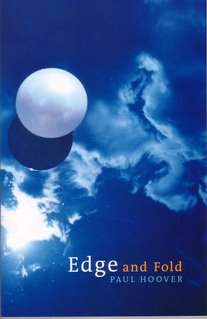
The title of Paul Hoover’s Edge and Fold suggests that the lines of poetry that run through the book approach the limit of the page (the edge) or are cut off in mid-utterance by a fold in the page. In either case, the contemplative fragments are assembled in small piles and often feel like cut-ups. However, the fragments themselves are often lent an aphoristic quality as well. Yet the term aphorism doesn’t seem quite apt either. The assembled fragments that beg for contemplation are more incomplete, more like koans. Yes, in Edge and Fold we have an admixture of cut-ups and koans.
This characterization is somewhat disingenuous, for it is quite reductive. The piles of lines that are assembled in the first section of the book (entitled “Edge and Fold” and which is comprised of 49 short contemplative pieces) do not just stand alone as lines that either do or do not enjamb with the following line. The short pieces are often whole unto themselves with a movement that carries the reader safely down the page despite some daring leaping from rock to rock.
The contemplative space carved out by these short poems is not just a space of objects and abstractions. Often literary or other cultural figures make their presence felt within the almost prayerful space created. During the first ten sections alone references to Fassbinder, Miles Davis and Zeno’s arrow are made. These references make the poems seem like prayers made to or for the benefit of others, other cultural figures whom Hoover has deemed worthy of letting them camp out in his head. The question remains what kind of god might listen to such utterances.
Certainly it must be a god somewhat interested in puzzles.
VIII
edge and fold
the raiment of the field
the harrow breaks it down
harrow of sight
with its articulations
nothing is in passion
when all is in belief
the world keeps turning
to face the burning sun
The voice that is speaking here (if one would even venture to call it that) seems to be devoid of passion. Nothing seems urgent about its articulation. All desire seems to have been vacuumed out of the world. Desire and its compulsion for a speaker to interact with the world have been displaced by belief, a mental operation. Yet mysteriously the world keeps turning in this state to face the sun, the source of all life, the source of all desire in the universe. The poem seems to be some sort of hazy commentary on the mortal combat between desire and belief.
The theme of the difficulty in trying to connect to the substance of life also occurs in segment XI.
XI
he loved the mechanisms
of wire and device
tipsy monuments
gadgets of craft
and this of all things
the most uncertain
an effortless pursuit
of everything he knows
along the coast of meaning
where structure is momentum
and life tries to keep him
in the tuning of a sequence
This almost seems to be a character description of a netizen. The copious amount of engagement with the transcendent puts the real substantial life at a disadvantage. It can’t compete (even though life has as its own ambitions to keep people in tune with it). From this little prayer-like sample, it is clear that God must be Google, where more and more people take respite and seek wisdom every day.
This fragment is where Hoover introduces his epistemological frame. In this series of poems he is concerned about knowing, in particular how the mind inscribes the nothing and in the end inhabits intelligible thought, intellection.
fromXIII
the more abstract it is
a cloud of unknowing
crosses all my minds
what reason for knocking
at an empty house
what reason for staying
The series is greatly concerned with affairs of the mind. Already for some poets this may be a reason to look for an offramp. Many poets whose main criterion for reading poems is to recognize desire and feeling in the world may become uneasy at the prospect of meandering through Hoover’s thinking selves and spaces. If this were to be the case, this would be unfortunate. Desire in the world without its counterpart of thought directing said desire is almost as entertaining to watch as dogs striving to rip meat out of each others mouths (I freely admit I don’t get the appeal of ultimate fighting).
For many readers a poem that is not explicit about what its intentions are, a poem that is not up front about its desire, is a poem that is not worth reading. In this, Hoover echoes their sentiments by asking what purpose there is in knocking at an empty house, furthermore, what purpose is there in staying at such a house. But just as one would discover many things about the desire that once may have nicked walls, damaged countertops, scratched window frames, stained cutting boards by entering into an empty house, one can also come to peruse the artifacts of the house of Paul Hoover.
So what kind of house is this that Hoover has built with “Edge and Fold”?
It is a house that is, too, quite barren. That is for sure. It is a house where one’s perceptions slowly begin to inhabit it. How one comes to know these occupying items is through cognition, that nearly inscrutable table game where everyone’s tokens scramble after the next play. It is the tale of the meaning machine, the human mind that has let everyone come to know it a little bit better through its addiction to language.
In the series Hoover is intimating what happens when the human mind is weaned of its obsession with language. Bit by bit Hoover unveils the somewhat dissembled magic that happens within the cortical folds.
However, as a reader, I am struck by how many times when I make Hoover’s lines the object of my focused attention, I am able to weave back together the strands that he has splayed before me as reader. I become a reader of the frayed. Such a method suggests that Hoover’s maxim for this series might be: all is perception.
Certainly Hoover seems to suggest that perception is the source, off of which he intends to hang the heavy machinery of intellect and cognition. But two sections later in XVII, he states, “the world’s as real as thinking” in italics (so he either really means it or he’s cribbing it from elsewhere). Here the heavy machinery isn’t just working to build some extraneous commodity. It’s building the world right where we stand.
And we are standing. Stillness pervades nearly every poem in the series. There are no actors, just reports on physical events: the dampness rolling in, a parrot wipes its beak, the crumble of a star. We are told in XXIII “at the edge of nature / a fold creates something.” These “somethings” accumulate through the series and provide little outposts for the attention to focus on. They are part of the “radical weather”that transpires. Then we are reminded as readers that language is connected to this world, sometimes in tenuous and unsatisfactory ways. The language, in turn, manifests itself as a kind of world that runs parallel to the physical world. Hoover comments on this in XXVI when he says “no word / or world / is empty.”Language is as full of potential for wonder as is the physical world.
In XXVIII Friedrich Hölderlin is invoked, and it is clear that Hoover is pointing to Hölderlin as an example of a man who took the world of the insubstantial more seriously than he did the physical world. Hölderlin’s main concern was with the gods in the aether. He communed with them, late in his life when he wrote his fragments, more than he did his physical surroundings, and for this he was declared insane. His enigmatic fragments parallel Hoover’s fragments in Edge and Fold. His language attempts to inscribe his experience just as Hoover’s does, but both ultimately fall short of accomplishing this completely, preferring in their own right to luxuriate in their own being—Hölderlin holding vigil with the gods, Hoover with his “wonder.”
In the blog entry by Hoover linked to above, Hoover seems to be locating postmodernism’s key aspects of dispersion, digression and openness with Hölderlin in the early 19th century. The grounding of postmodernism to Hölderlin underscores postmodernism’s legacy as much longer-lived than many might acknowledge, even if it’s longer life comes packaged with the mad Hölderlin.
In XXX Hoover makes reference to Empedocles (whom Hölderlin wrote of in his play Death of Empedocles). Empedocles is another tale of self-delusion, even willed self-delusion. Legend has it that he threw himself into an active volcano so that people would believe that he had vanished and turned into an immortal god. Hoover’s treatment of Empedocles is somewhat different. He has Empedocles “at the brink / tenderly walking back / to the house where he was born / laurel leaves scratching / the softest of walls.” The laurel leaves conferring his godly status appear to be more grounded or at least this is one reading of those soft walls (not the presumably hard walls of the volcano). Another reading of the soft walls might be the skull. Indeed in XXX1, Hoover takes the reader back into proximity with the body, with lines reading: “the body is a field,” “the eye can’t imagine,” and “thickness of a hand.”
One of Hoover’s obsessions in “Edge and Fold” is the way in which language interacts with the physical world:
XXXV
in the sparest of ruins
language is act
where one can imagine
the unbuttoned present
with its ripe interjections
and swerving cars
the way green mold
covers a lemon
& stone asks a question
the moon must answer
This section has a very Hölderlin-like movement. The zigzagging from one line to the next in the couplet is reminiscent of the way Hölderlin zips from one detail to the next but is not altogether concerned about tying things up. The physical world presents itself one item at a time, and Hölderlin’s mind travels distractedly among them. The gist of what Hoover is talking about with language being the act where one unbuttons the present is exemplified in the fourth couplet. As a reader, one identifies “The way green mold / covers a lemon” as a perceived phenomenon, a detail that fills up the nothingness of experience with wonder. It unbuttons the present.
In the very enigmatic XL Hoover invokes Pascal, in particular it seems his famous wager that it is better to bet on a God and have him not exist than to bet against a god and have it turn out that he did exist. Hoover’s resolution?—“god goes nowhere / breathes all air / infinity is memory / when a god plays life.”Then a god too is subject to being create out of nothing to reside in the infinite memory of the living.
Wislawa Szymborska provides the epigraph for XLI. It reads: “where is a written deer / running through a written forest.” This section deals with the written word. The written is pitted against the unwritten, the two being mutually opposable forces, but by the end of XLI one sees that the written is dependent on the unwritten, the still, the empty. The last line reads: “everything that is / written by what is not.”
Perhaps my favorite segment is XLVI.
XLVI
a lovely winter wedding
for every mother’s son
in a world of afternoons
social observations
mean almost nothing
Taylor loves John
a mirror loves the sun
each time I dream
it happens more slowly
until a fondness comes
My initial response is to ask a fondness for what? Maybe “fondness” is just a cheap stand-in for desire here. Or perhaps it is pre-desire, the moment of inclination before desire roots inclination in the world. The slow-in-coming dream that is the trigger for such a moment is a notion that is truly sublime. It makes me want drag the apparatus out of my closet that lets me measure the velocity of a dream.
Equally intoxicating in XLVII are the lines: “the semblance and the tangle / are models of desire / little sleep machine / on its way to language /flickering out of time.” The semblance is the moment of wonder where one renders a perception in language, the moment when “something like euphoria relaxes into genius.” The tangle is the result of prolonged engagement of perceiving, the hard looking again and again that ultimately brings a perceiver to his attachment to the world. Both the prolonged version and the immediate version of desire must make their appeal to language to be brought into the fold of existence.
By the end of the poem one has traveled over a lot of terrain, both psychic and experienced. Though the poem may last an hour or so in one reading, the lived time by the maker is much longer. The poem is concise and scrutinized, yet it has enough breadth to remain an interesting exposé of a mind pushing into the world, not one circling its own navel. There are many centers of attraction within this system that Hoover has built: language, experience, desire, nothingness, perception, cognition, nature, mind, zero, one, infinity. The connections between these themes is what eventually keeps the poem from being totally frayed. Many of these themes turn and angle in on the others, and while this system is a looser assemblage than what I might be used to and aim at for myself, the openness that it achieves makes this system one that is set to expand at its outermost edge even as one is tempted to fold it in on itself in order to make a nice, neat bundle that one can carry around in the back pocket, to carry it around like a handbook for ideation.
In “The Reading” the other long poem in Edge and Fold, absence is again a major player. It covers much of the same ground that “Edge and Fold” does with its theme of “creation needing its rift, busy with silence.” The main difference is that the first person singular makes a few brief appearances. Perhaps it signals that there is less distance from the author in “The Reading” than the detached voice in “Edge and Fold.” “The Reading” also seems a bit more playful as well: “I am not well / between heaven and hell / and guilty of a crisis,”also its reference to “inaction painting . . . silence between the lines, color between words.
The inaction painting is presumably the text itself. It is the place where one as a reader remains immobilized in order to ingest it while the words swirl around in their patterns that are perceived due to the exertion of a reader’s concentration. Ironically, it is out of the mix of the physical world that language with the help of desire fixes experience during a moment of creative insight. Then a reader in a moment of stillness permits the language that has fixed experience to become active in the mind. The transmission is complete. This is what “The Reading” seems most to be about.
About the fragment it is Donald Revell who writes:
The interruption of the incessant this is the distinguishing characteristic of fragmentary writing: Interruptions having somehow the same meaning as that which does not cease. Only what cannot begin cannot end. Once begun, an activity possesses trajectory, and, anticipating a form, trajectory anticipates an end.
Only what cannot begin remains innocent of anticipation, retaining the necessity and thus the privilege of incompleteness. In trying to understand the fragment as a genre rather than as an abolition of poetic activity, I want to find some of the accents of such innocence and some of the attributes of its necessity.
The innocence that Hoover has commenced in “Edge and Fold”is a sequence that defies succession or at the very least makes of it a grand parade of wrong turns down rarely traveled alleys. The assemblage that he has put together touches one fragment to another at the loci of a few abstractions like nothingness, mind, perception, desire, even fewer figures, to arrive at an ars poetica of the sublime moment of creation, of inspiration by the gods in the way Hölderlin might understand it. Yet the incompleteness that is its privilege, as Revell describes it above, always glistens with possibility. If one had a special set of enzymes where one could recombine these fragments, the resultant mongrel of a species could be taken along on a trip up the side of the Alps to see the gods in the aether.
Subscribe to:
Posts (Atom)