Wednesday, December 13, 2006

SOME NOTES ON "THAT DAY" FROM DAVID TUCKER'S LATE FOR WORK

I have been reading and re-reading Late for Work by David Tucker. The book is, in a sense, a collection of procrastinations, never-happened-but-what-if-it-hads, and nothing-has-happened-but-something-else-kind-of-dids. My intention was to review the book in its entirety a full two months ago. But the entropy of life has kept me staid. In reading and savoring Late for Work I think this indolence a fitting appreciation of Tucker’s “putting everything off” aesthetics.

While the humor in Tucker emerges from his musings on wasting time, the darker resonances come from matter-of-fact reports about how things happen: the breathy “oh” of a loved one, a boy forgetting the jacket he wore before taking a beating from his father, and the odd greenery the sick and dying call to mind for those in audience.

Tucker’s matter of fact tone and style enables him to handle memory and flashback with all the flare of a competent storyteller. But what I like most in Tucker’s voice is his understated, unsentimental sentiments. I’ve found myself thinking a lot about several of his poems, but in particular I found myself thinking about his poem, That Day.

Many of us have sick or dying parents—the last place we tend to reach for is our own sadness as that would make us self-indulgent and do a disservice to the parent we love. In That Day the poem moves the reader along an emotional arc that we all bank around when feeling our way through the long term illness of our loved ones.

In That Day the poem spends so much time lavishing in its “nothing day” that the reader falls prey to the same languor allowing the reader, perhaps, their own reverie of their own once-healthy mother to flood the plains of their imagination. The poem, so specific to the boy and his mother, makes vivid a defining moment and yet the details of the shortcut, the sack of groceries, even the flushed quail are common enough to trigger the repose that opens memory to its heart.

Of course such ravishings of memory must be undercut or we fall prey to the snickering of our own cynicism and here is the magic of Tucker: without falling prey to cynicism he finds a way through thickets of emotional snags without letting the poem or the reader slip over the edge into an unrestrained, undifferentiated mess. In That Day the poem slides the mother’s illness into the reverie—slides the future into the past.

Here is the poem…

That Day

It happened long ago.

--“Encounter,” Czselaw Milosz

Walking back from town they somehow missed

the logging road that makes a shortcut to their house

and now they are vaguely lost – the mother and her son

on an evening near Christmas in 1960, but they know

the road is close by and that they’ll find it soon.

The mother sings some song we can’t quite hear anymore

as she carries a sack of groceries on one arm

while the boy wades around her. Kicking the dry leaves.

Halfway down a hill, a quail whirs up from a thicket,

the wingbeats fan the boy’s hair as he grips

his mother’s hand and turns to watch the bird disappear

into the woods. A calm nothing day. It happened long ago.

In a few years his mother will begin hearing voices,

first at night, then all day. She will be committed

to an asylum in Nashville and it will seem that nothing

can bring her back to ordinary life. Then, after twenty years

of doctors and drugs and nothing working, a calm will descend

slowly, as if on its own, and she will become her old self again,

only sharper, wittier—like one lost a long time who at last finds

the wide road home. But it’s all still far off as they walk

to the house and to supper on that evening in 1960,

the boy happy, the mother singing as they found their way

to a future they wouldn’t believe, even if I told them.

When I think of my own mother’s battles with her own illness over the last twenty years, on account of Tucker’s poem I’m afforded the invaluable luxury of returning to images of her from when I was in Kindergarten, she in her black and white horizontal striped sweater, her Jackie Kennedy hairdo, touchdown Jesus in the background as we walk across the mall of the university. Her holding my hand, and we are off to the dentist…a place I hate more than anywhere else in the world; a place I would only trust my mother to take me. Of course this is just one memory of her in her healthy vibrant youth—but it is a recollection that I would not have had if it were not somehow permitted me by the imaginative compass of the poem That Day by Tucker.

While not brave enough to write poems like Tucker myself, I find myself grateful that Tucker’s inimitable, simple, putterings and loafings held me still long enough to call forward what I otherwise might have set aside.

Sunday, December 10, 2006

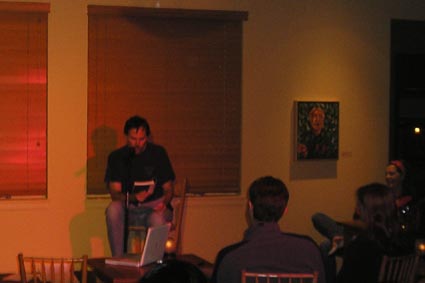
Joe Wenderoth at Bistro 33 in Davis


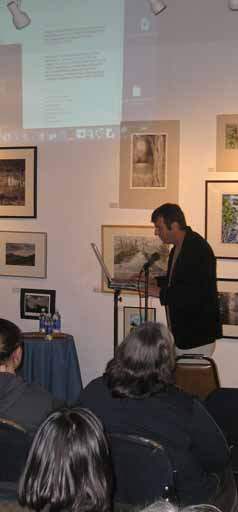
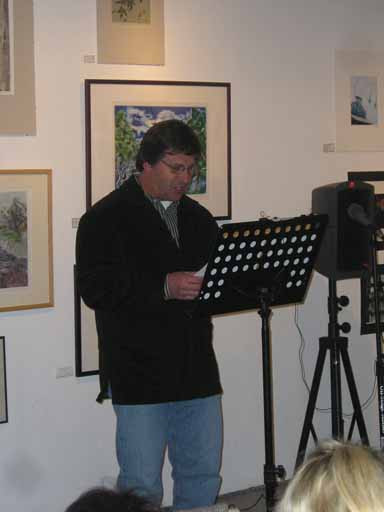
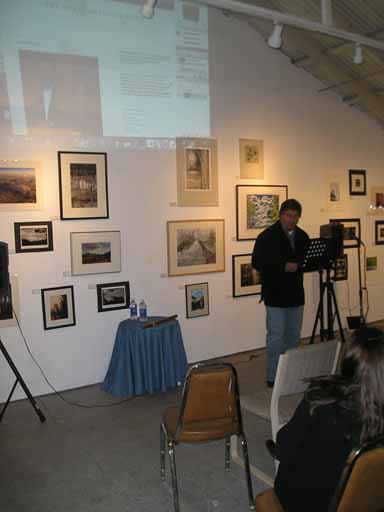
Joe Wenderoth appeared at Bistro 33 in Davis, California to read for an extended period of time.

Hosts Andy Jones and Brad Henderson kicked things off with a few poems of their own, and then Wenderoth started out singing some down home blues songs (accompanied by Jason Morphew) and finished off his musical set with a semi-derisive (yet still reverent to big Hank) rendition of "I Saw the Light."

Wenderoth then read a long and involved piece about Tony's, a strip bar in Baltimore, that features some unusual fare in contemporary stripping. The emphasis at Tony's is on the strippers' not titillating the patrons but invoking schadenfreude.

He then proceeded to read several selections from what was hailed by Rolling Stone as one of the notable books of 2000 (a fact that Wenderoth disputed), namely, Letters From Wendy's. The central project of this book is that Wenderoth composed each one of his entries on a customer comments card at a Wendy's restaurant. The book is the sum total of his efforts at "improving" Wendy's for future customers. Wenderoth expertly reads selections from Letters to Wendy's, and if you close your eyes, you can almost see him briefly lick his lips when he delivers one of his drop-dead funny, tongue-in-cheek lines.

Saturday, December 2, 2006

THE GREAT AMERICAN PINUP READING Tuesday Nov. 28 in Sacramento, CA

Every once in a while, one finds one’s name in the spotlight.


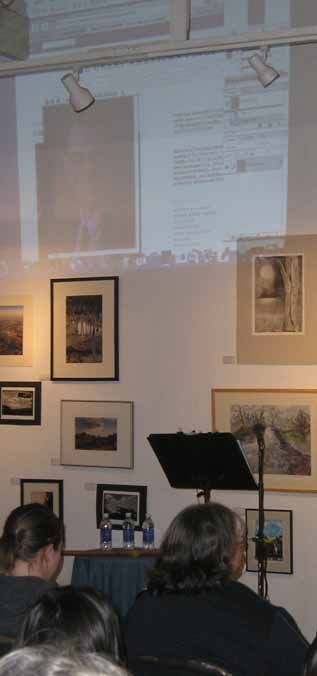
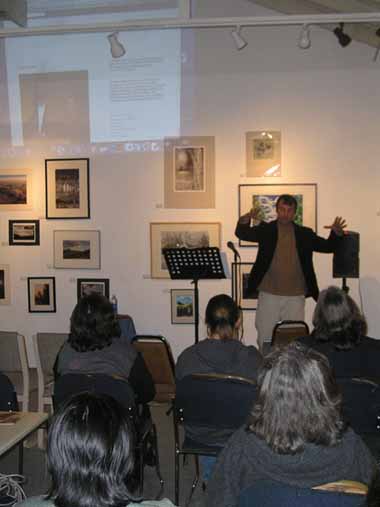
Such was the case in Sacramento, CA on Nov. 28 that The Great American Pinup assembled, with live bodies and with disembodied voices. David Koehn, Victor Schnickelfritz, and Shawn Pittard appeared before a brave crowd who weathered the second and coldest night of what was described as an “arctic blast.” Geraldine Kim fell prey to a virus (as did Matthew Schmeer’s voice on several pieces that were played). Richard Jeffrey Newman as well as Schmeer were featured via recorded voice.

Victor was the host of the evening and after briefly rehearsing the history of the two-year-old blog and what it has endeavored to achieve over that time, he read the opening piece of the evening entitled ”Wonder”.


Then Matthew Schmeer’s “accountant” picture floated above the crowd like an avenging ghost while his voice was heard reading: “Raisin Ode,” ”Waiting,”“Poemsauce,” “Outside Banning, California,” “Driving My Mother to Her Grave,” and ”1-800.”

Victor read two more poems that illustrated his interest in merging the spoken voice with the singing voice that “quotes” pop songs and other varieties of song, similar to the way selected lines of verse were sampled in poems written in the past when persons, who kept many lines in their heads, would recognize them. The first one, ”Ohrwurm” referenced Antonio Carlos Jobim’s “Agua de Beber” and the second one, “Tent of Maybe, Dream of Home” referenced an obscure Paul Simon song entitled “The Teacher.”

David Koehn then read from his re-released chapbook of poems called Coil. In one of these poems he attempted to “jump the crowd” (see below) in describing how one fishes with a net.


Then, like a latter-day Bob Dylan, Koehn switched to his “electronic set” and read a poem of his that was so new it had not yet been transferred to paper.


Then the soulful baritone voice of Richard Jeffrey Newman hovered in the chill air as it went through ”Because”, “After Saying Goodbye to You Three Times in Three Days,” “Dear Yoon,” “Dear Ji-in,” “After Dancing in the Diana Nightclub with a Woman My Friend Paid For Against My Wishes,” and ”The Silence of Men”.


Shawn Pittard finally rounded off the evening by reading from his Oct. 24, 2006 post about Robinson Jeffers. He explained how The Great American Pinup has been a venue where he has taken great pleasure in exploring what he had to say before he knew what that was. Then he read the poem that is found on the Oct. 24, 2006 post by Jeffers entitled, “Birds and Fishes.” At long last, wishing every one in the audience a speedy recovery from their frostbitten tissues, he read a poem that had been inspired and influenced by the Oct. 24 post.

The crowd shuffled their feet to get their circulation going, and the hope was that fond thoughts of the evening would continue to circulate through the dark of the Sacramento night and through the interstices of the world wide web.

Monday, November 27, 2006

SAMINA ALI


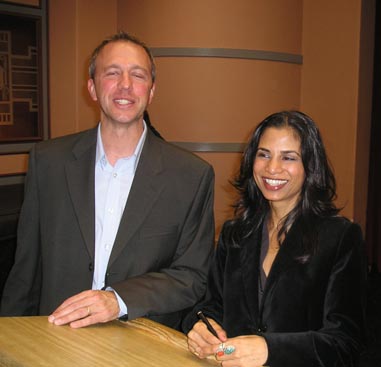
Samina Ali, pictured here with mesmerized host Jeff Knorr (or is he fighting off the effects of his medication?), appeared in Sacramento City College's auditorium for a reading and discussion of her book Madras on Rainy Days.

Samina Ali read an excerpt from her novel before a packed and attentive crowd.

She proceeded to field a number of questions from the assembled crowd. She talked about the reasons for Islam's divergence from its stated rules regarding women's choices and opportunites and the effect that the overlay of cultural practices in states that have adopted Islam has had on Muslim women's choices. She also touched on the nature of the novel with respect to her experience, emphasizing that there was a good deal of difference between her experience and the experience of her characters, particularly regarding Sameer (the husband of the female protagonist Layla) and her real husband. However, she did let on that much of the book was based on her experience.

Everyone left the auditorium a little more informed and enlightened except for your humble reporter whose offer to have Ali appear as "Ms. January" for an upcoming pin-up calendar of Muslim women of California was rebuked. Alas, if only my shame were a perishable fruit!

Tuesday, November 21, 2006

GIVING THANKS: JANE KENYON'S "OTHERWISE"

Some mornings I push the paper aside, click off National Public Radio's earnest voice, and simply drink my coffee looking out into the back yard. A 22-year-old Marine Lance Corporal was killed in Anbar province last Sunday. Sy Hirsch says intelligence concerning an Iranian nuclear weapons program is muddled at best.

It is autumn and rust-red dogwood leaves gather on my patio. I listen to a black crow's conversation through the kitchen window. I remember a poem written by the late Jane Kenyon. A good poem to read again two days before Thanksgiving.


Otherwise

I got out of bed
on two strong legs.
It might have been
otherwise. I ate
cereal, sweet
milk, ripe, flawless
peach. It might
have been otherwise.
I took the dog uphill
to the birch wood.
All morning I did
the work of love.

At noon I lay down
with my mate. It might
have been otherwise.
We ate dinner together
at a table with silver
candelsticks. It might
have been otherwise.
I slept in a bed
in a room with paintings
on the walls, and
planned another day
just like this one.
But one day, I know,
it will be otherwise.

Tuesday, November 7, 2006

Core Samples from the World

Along China's Western Edge

Note: This is the first in a series, core samples from the world. Not meant to serve as travel guides, much less as any sort of informed historical narrative of regions with which I have, often, only cursory acquaintance, these prose passages are personal, particular, often peculiar relations of encounter between poet, poetry, and place. They are the notes of a wayfarer, and of the kind prone to missing the festival in the square because he was squatting to watch a worm fight in an alley.


At Chicago’s O’Hare, boarding the flight to China for a two-part international poetry festival that begins in Beijing and then moves to the far western Xinjiang Autonomous Region. When the steward takes my ticket, I notice fluorescent orange earplugs dangling from a string around his neck. Are my first instincts always self-protective and proprietary that I wonder, What does he need them for, and where are mine?

* * *



At the Xi Xuan Hotel in Beijing, we take the stairs from the lobby down to the basement conference area. The ante-room is opaque with smoke, otherwordly, like a waiting room in Hades. Local poets furiously lighting up before the panel begins. The guidebooks suggest bringing presents to a Chinese host or business partner, and good quality cigarettes, Marlboros in particular, are recommended. The first time I visited China, I brought them. But it felt complicated, from my perspective, coming from a country where smoking is banned from most public spaces, where the dangers are so specifically categorized, to express personal fondness with a carton of tar and methane. On the other hand, as I will find, the Chinese have no qualms about trying to embalm me with compulsory shots of bai jiu and endless toasts. It’s curious that bonding is so often a kind of coalitionary self-destruction.

In the conference room, we take our seats, the hosts are thanked, the press identified, the writers, thirty Chinese poets and a dozen international poets, introduced by Xi Chuan, our bilingual host, poet, and thinker, a man at ease in his body. He looks down when he talks, unconcerned about eye contact, and periodically swipes hair from his eyes. During the long passages in Chinese, I begin to see that the gestures of his hands are also organs of language.
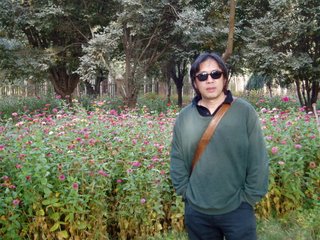


Xi Chuan
* * *

Now the roundabout of first comments. German poet and translator Wolfgang Kubin credits Ezra Pound’s translations for turning him, forty years ago, toward China. The mic goes to Scottish poet William Herbert, to several Chinese poets, to Kazuko Shiraishi, to French poet Andre Veltner. Tang Xiaodu, the other conference organizer, paraphrases Adonis: When I am abroad, I am most at home. Shimizu Tetsuo, from Tokyo, notes that unlike most poetry, haiku is the product of group endeavor. (I wonder if writing in a public space, in a café, for instance, is a Western variation. We tune-in the energy of a public setting, but without relinquishing control?)


Yang Lian
* * *

Ex-patriot Chinese poet (living in London) Yang Lian quotes Tu Yuan’s “Question to Heaven” and identifies poetic endeavor as a questioning. Then he says, “If it weren’t for the substance of poetry, we wouldn’t be worthy of our own experience.” Emran Salahi, who will die of a heart attack two days after the conference, Salahi, the sweet-natured poet from Iraq, speaking Persian, says, in response to my question about traditional Persian forms, that his own poetry is quite modern, unrestricted by traditional conventions. (Later, I will see that what he means by this is that he writes in free verse.) The famous calligrapher and poet Ouyang Jianghe notes “Every mature poet has his particular vocabulary.” Che Qianzi, one of the younger, experimental Beijing poets, responds with a spontaneous poem, “part haiku,” which plays on the names of the two Japanese poets, Kazuko Shiraishi and Tetsuo Shimizu. The conference organizers, Tang Xiaodu and Xi Chuan, offer summarizing observations on the unsettled state of contemporary Chinese poetry in a culture shifting at warp speed. We don’t want to go backward, Xi Chuan observes, but ahead of us, the ways fork in innumerable directions and each is hemmed with liabilities and responsibilities.

Given the gravity of the discussion, it seems the panelists mean to map out a future for Chinese poetry, as though it might be prescribed, tagged with a five year plan. But I am merely inept at reading the forms of discussion here, much less the subtleties. What I take as evident bounces away from me. I begin to notice tensions, faces shaking no, one translator interrupting another to retranslate a comment into English. The topic, Where is Chinese poetry going in the age of globalization, is enormous and of course the answer will be found in poems, not panels, so I try not just to listen, but to listen into. What else is being asked, what is at stake for them?
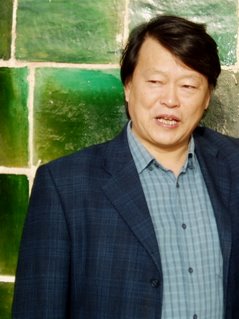

Tang Xiaodu
* * *

Five airless hours after the first conference panel begins, we swarm back through the ante-room’s cigarette nebulae, and back up the stairs to the hotel restaurant where, exhausted, we plop down at round tables and aim our chopsticks at the endlessly various plates and bowls circling on the Lazy Susan.

* * *
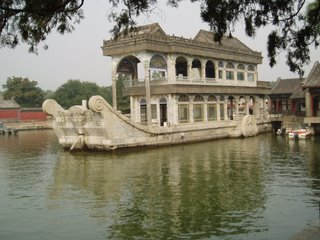
Stone Boat at the Summer Palace Lake


* * *
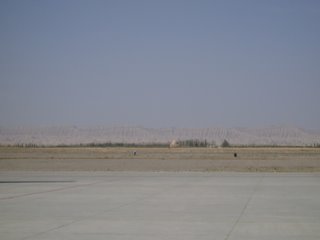

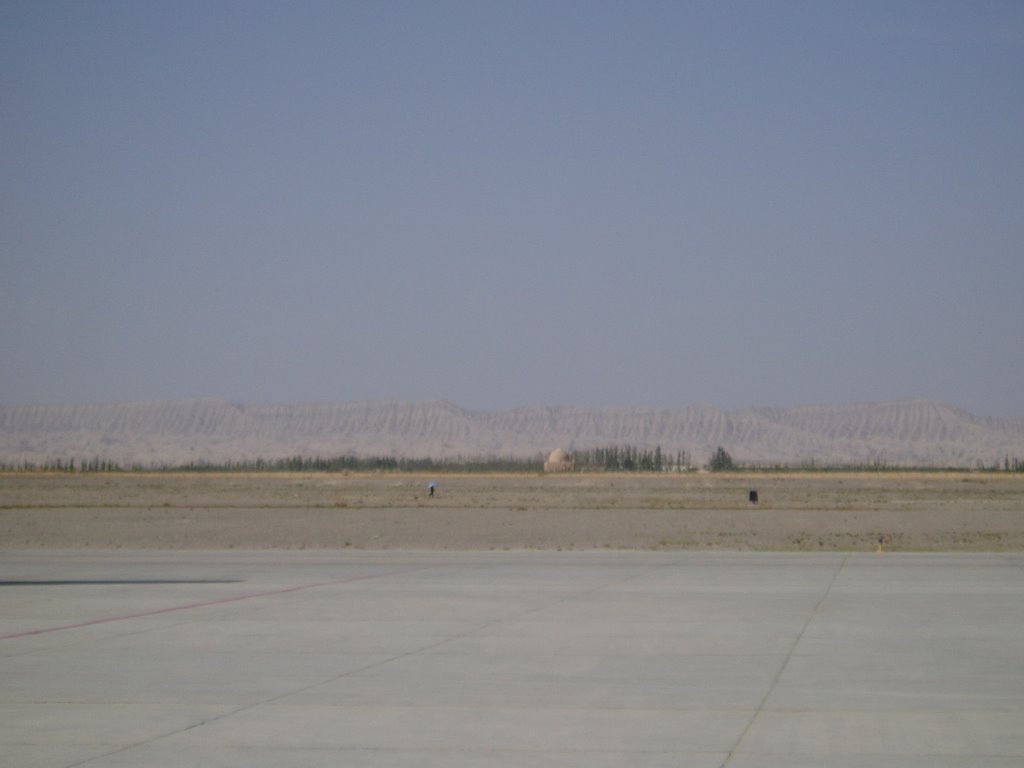
Kashgar Airport


* * *


At the Poet’s Tomb


* * *


Evening Prayer, Mosque Minaret


* * *
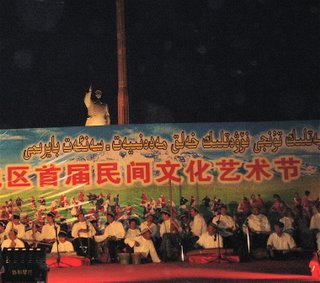

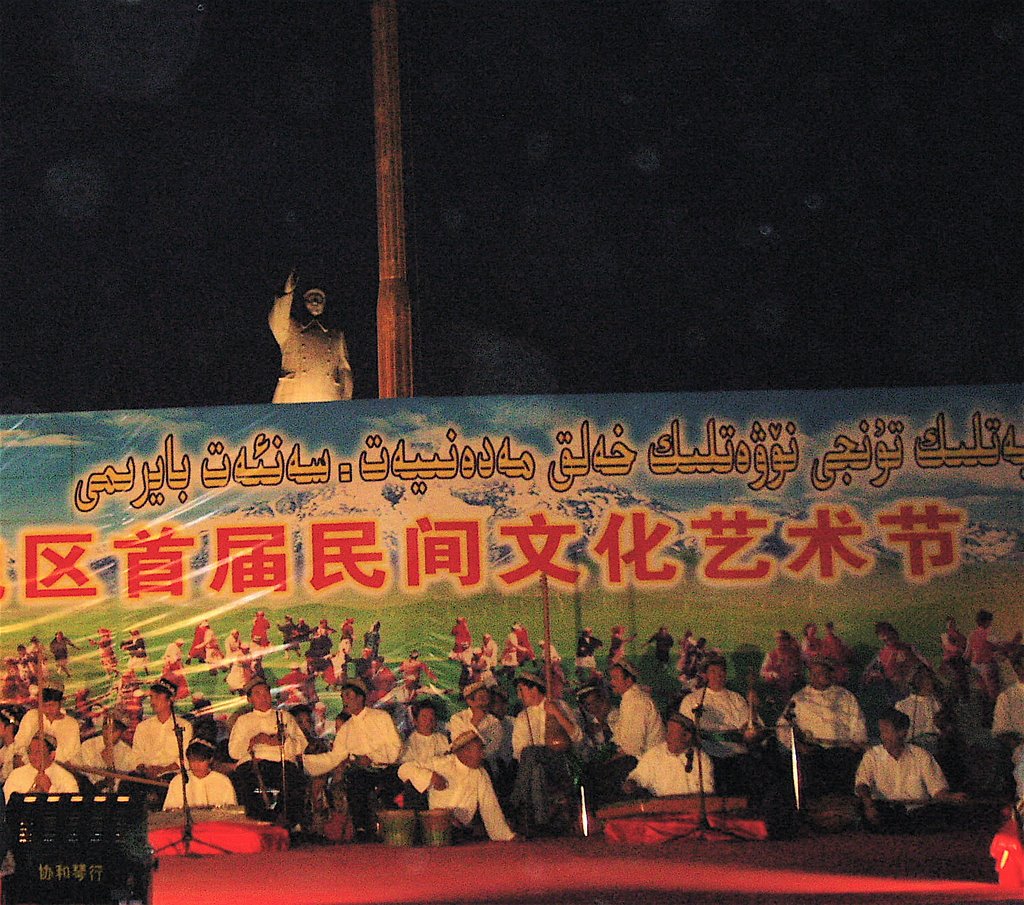
Evening Performance of Traditional Musicians, Statue of Mao Presiding


* * *
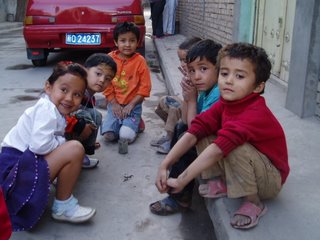

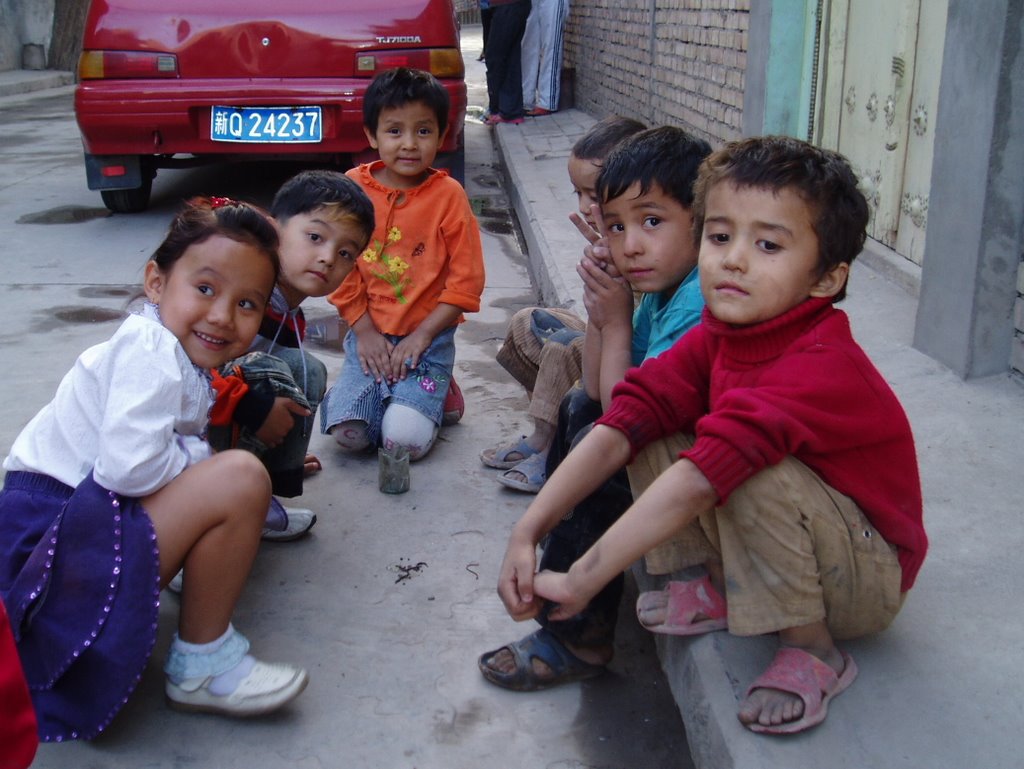
Worm Fight


* * *
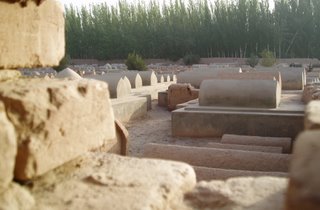

Cemetery in the Autonomous Region


* * *


Mountains in the Autonomous Region


* * *
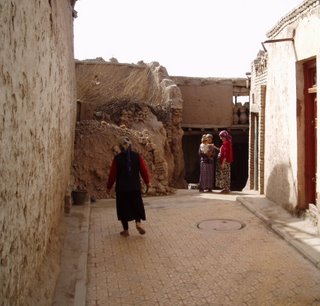
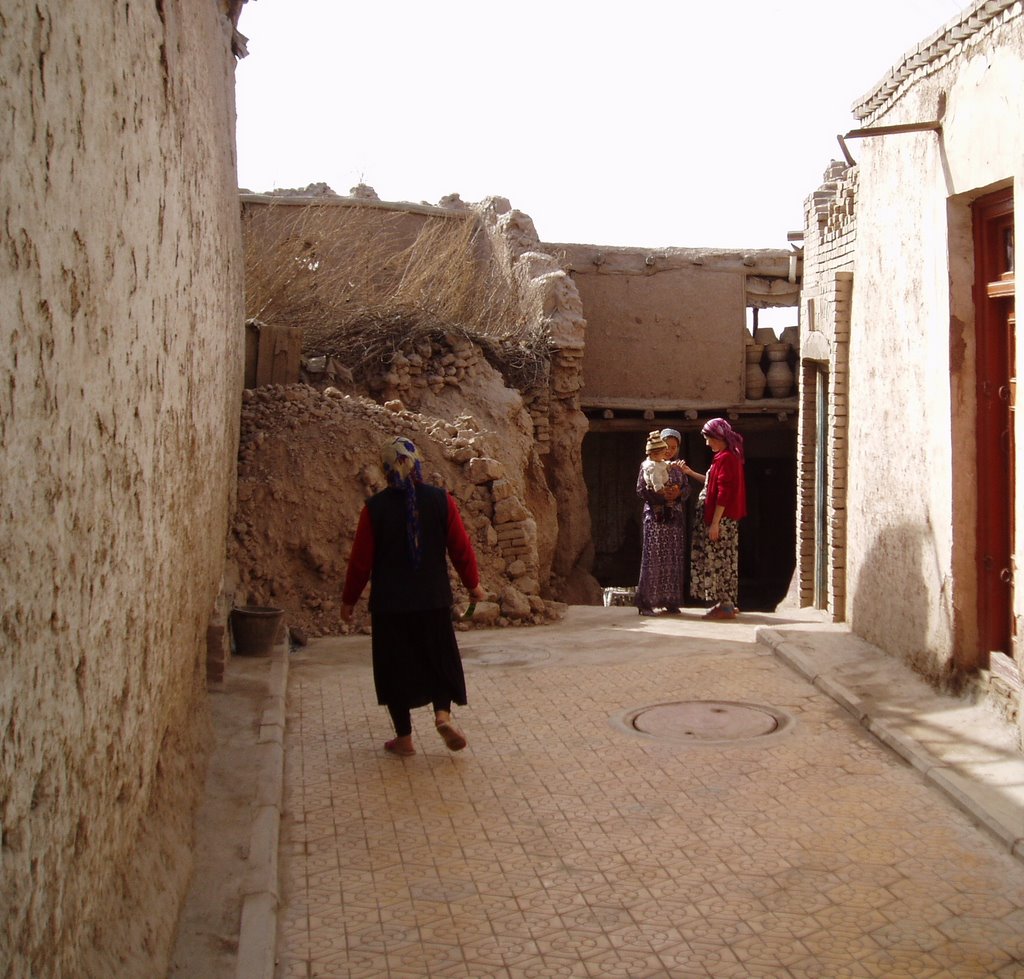
The Old City


* * *
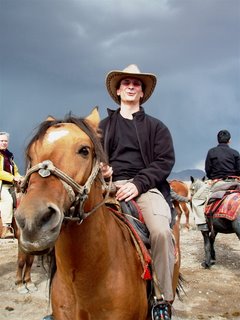

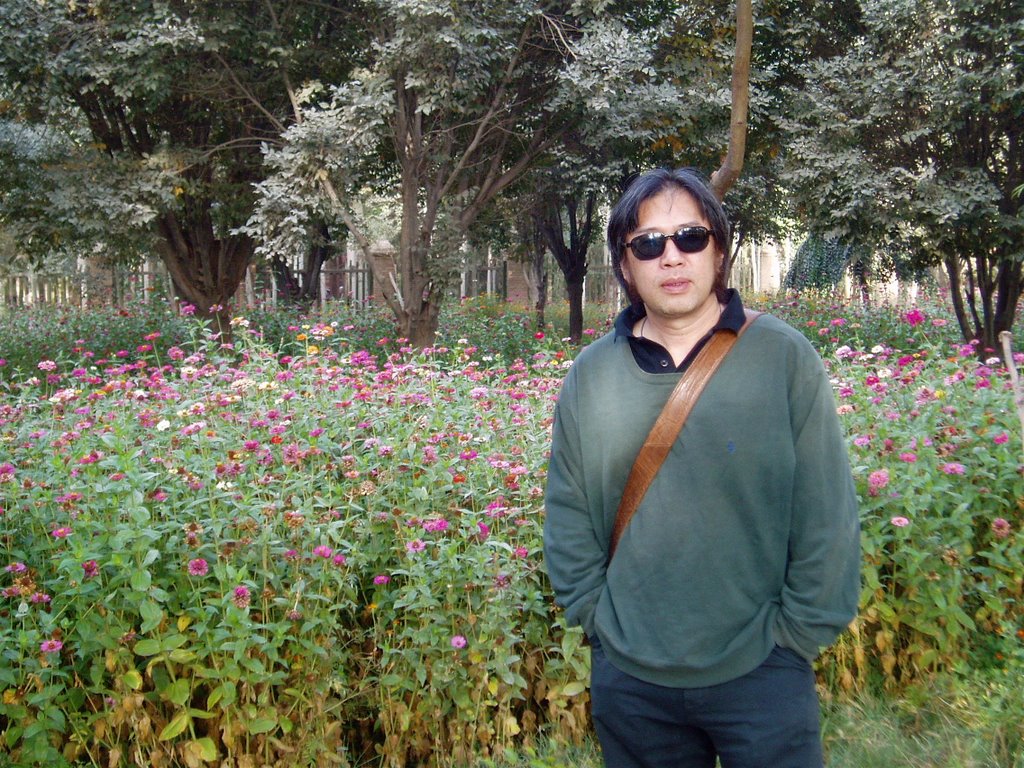
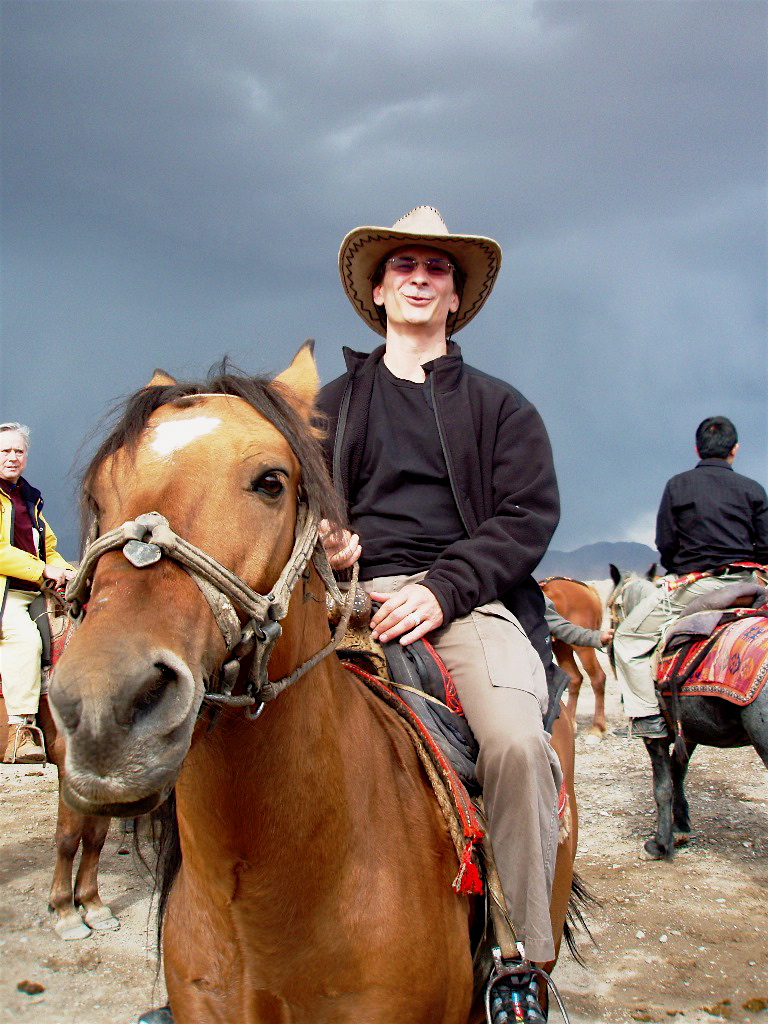
Author before the Storm


* * *

Where IS Chinese poetry going in the age of globalization?

I’m not so presumptuous that I would say. But certainly it is going to America, among other places. Here is a glimpse of some of what I see going on.

Bei Dao, a figure nothing like T. S. Eliot or William Faulkner, has achieved something of their status in China. Whether it serves as a model or a point of departure, his work must be taken into account by any serious Chinese poet. As Flannery O’Connor said of Southern writers in relation to Faulkner, "Nobody wants his mule and wagon stalled on the same track the Dixie Limited is roaring down." Bei Dao’s poems, translated powerfully by Eliot Weinberger and published by New Directions, don’t remind you of freight trains, but they carry a markedly evocative force. Here is an uncollected translation of one of Bei Dao’s recent poems that I heard him read in Chile, the audience enthusiastically swarming him afterwards.

Ramallah

In Ramallah the ancients play chess in the starry sky
the endgame flickers
a bird locked in a clock
jumps out to tell the time

in Ramallah
the sun climbs over the wall like an old man
and goes through the market
throwing mirror light on
a rusted copper plate

in Ramallah
gods drink water from earthen jars
a bow asks a string for directions
a boy sets out to inherit the ocean
from the edge of the sky

in Ramallah

seeds sown along the high noon

death blossoms outside my window

resisting, the tree takes on a hurricane's

violent original shape


Xi Chuan, who is more than a decade younger than Bei Dao, marks the beginning of a “new generation.” A critic as well as a poet, Xi Chuan is one of the poets most articulately involved in questioning the trajectory of contemporary Chinese poetry. Several Americans have been interested in translating his work, but almost nothing is available here.

Wang Ping, has lived in the U.S. for more than twenty years. Associated early on with Lewis Warsh and the 1980’s lower east side New York poetry scene, she helped to translate and call attention to the work of her contemporaries and, in addition to writing criticism and fiction, writes poetry. Her book The Magic Whip mixes prose and poetry, a formal equivalent of the themes with which the book is concerned.

Zhang Er, also associated with the New York poetry scene, with Leonard Schwartz and Talisman House, has seen her work translated by a panoply of good American poets, and her first major book in English, Verses on Bird, was published recently by the excellent Zephyr Press which also publishes Duo Duo, a riveting and influential poet who trained, not incidentally to his poetry, as an opera tenor.

Zhang Er has edited an anthology of Chinese poets, including the work of younger innovative poets like Mo Fei and Cao Shuying. It will, no doubt, play a major role in creating an audience for innovative Chinese poetries. In her introduction, she notes, with reference to the younger Chinese poets she includes, that: “Their work is complicated, filled with conflicted thoughts and emotions, which demand various writing strategies, as well as a wide range of vocabularies and forms. Their aesthetic stand, if I can speak for them, is in stark contrast with the conventional Western view of Chinese poetry's ‘pure, natural, clean, concise imagism.’ For sure, they use plenty of images, but they use them in their messy and maximum way, along with many other strategies. Their view of the Chinese language, as reflected by these writings in Chinese characters, is holistic: the images of things themselves, the human perception and understanding of things, and the human voices that name them. At the root of the Chinese writing system (the characters) live things themselves, not just the images kept as records but the acceptance of things themselves, things that do not need explanation or even to have a fixed articulated name. Human perspective, reasoning and voice are somehow treated in the Chinese language as secondary or even arbitrary.”

One of the edgiest of the younger Beijing poets is Che Qianzi, who has been impossibly but aptly translated by Yunte Huang. Huang, who is known in China principally for his translations into Chinese of Ezra Pound’s Pisan Cantos, is better known in the U.S. for his critical work and for his own poetry, notably the high-energy Cribs, published by Tinfish Press.

The brilliant, exuberant Hu Xudong, who teaches World Literature at Peking University and speaks of a plural inner self, writes a high speed, macaronic poetry that incorporates provincial dialects, advertisements, classical references, and surrealism. His most recent book awaiting translation into English is titled When Love is a Spreading Disease.
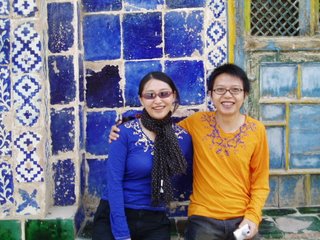

Hu Xudong (right) with Zhou Shu
* * *

Zhaiyong Ming, of Chengdu, is one of the most widely admired poets in China. Her early work is notable for its dense ambiguity, for its shifting fields of association and its dark intimations. Her more recent poems are limpid and precise, easier to translate. But Like Xi Chuan’s, Zhaiyong Ming’s considerable accomplishment as a Chinese writer has yet to be brought over into English in a collection that makes clear why she is so highly regarded.

In Shanghai, the poet Wang Yin makes his living as a photographer and writes the most vividly imagistic poems-- "one raindrop and then another/ on a power line"-- that I encountered in China. The images are made more complex by the lineation, which breaks through the framing syntax, but the emotional registers of the poems are clear and intense.
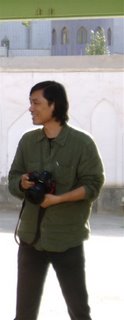

Wang Yin
* * *

Living in Providence, RI, Xue Di’s translated work has been well-received in the U.S. (even inciting comparisons with Rimbaud). And London-based Yang Lian’s ambitious, often book-length poems have been widely translated in Europe but are most readily available to Americans through Green Integer’s Yi and through Blood Axe’s Concentric Circles. Zhou Zhan, whose scholarly work has focused on translation and contemporary Chinese poetry, has a widening fan base for her own work which has been appearing in translation in England and the U.S. I’ll close this essay with a poem of hers from the series Death in Childhood. It is translated by Susan M. Schultz and Jennifer Feeley.

Debtor

He used his sign-off to repay
money owed in this world of dust the rope
borrowed in perpetual debt
as though everyone alive became his creditor
secretly condemning him all solutions to follow the one
child witnessing death for the first time
in constant fear of life’s debt
death is itself not frightening it’s only prolonged
a person’s body posts his shadow
on memory’s earthen wall
takes an old man’s voice while he lives
shutting it behind the wall . . . she startles
awake from her dreams hearing the cadence of his speech
his chatter about the weather about bees
and summer’s mosquitoes (children can’t fathom
boredom) using boredom’s quickening, life
arrives appearances swiftly change—now he’s dead
he’ll never again grow old his body slender
at the intersection of dreams arousing her adult desires
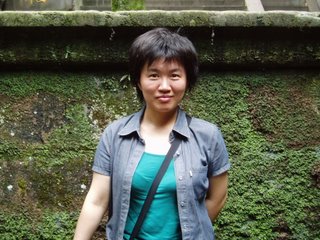

Zhou Zhan
* * *

Thursday, November 2, 2006

SOME NOTES ON THE HENDRIX-MURPHY FOUNDATION PROGRAM CATULLUS TRANSLATION WORKSHOP AT HENDRIX COLLEGE

Many might find visiting a college campus and spending a Friday and Saturday in colloquium with students and professors run of the mill. When Hendrix College and their Classics professor, Dr. Rebecca Resinski, provided me a small grant to visit with their Classics students on October 27th and 28th to work on translations of Catullus I felt blessed.

While I regularly travel the world on business, rarely do my artistic pursuits provide entrée to such opportunities. To wake Friday morning in the beautiful Hulen Hall on the subtly sublime Hendrix College affected me deeply. I looked over my notes on translation—a few scattered thoughts I would share with students.

I looked over the translations I would read on Saturday morning there in Hulen Hall during colloquium. I would be reading translations of Catullus Dr. Resinski informed me had already been published at Lucas Klein’s journal Cipher. See: http://www.cipherjournal.com/html/koehn.html.

I do wish Lucas would communicate with me as I have no idea when or if he ran these translations. I sent them in July and was informed by Dr. Resinski about their appearance at Cipher. I wish I knew more.

I closed my morning with a browse through the student translations of Catullus’ 1, 5, 7, 8, 12, 13, 22, 24, 41, 43, 48, 50, 51, 69, 70, and 99. The student translations struck me as accomplished—but even more impressively they had that feel of things made not by a process but of things made by the human hand. Their translations possessed a texture like hand-woven cloth or hand made paper--some times rough, sometimes delicate, but always imbued with a quality of concentration and diligence that only comes as a result of care.

Deeply impressed with the students and their translations, I felt my worry about having lost Catullus to the classicists at the expense of the modern poet misplaced. Part of me began to think, only students of such skill deserve Catullus. The intellectually lazy and generally muddled minds of most contemporary poets don’t possess the nuance of imagination let alone language to appreciate what Catullus offers.

Against my better judgment I shared with the students, what I think might be a mistaken thesis. My proposition that the modern poet need reclaim Catullus. This may actually ruin him. The students I worked with possess such detail-oriented Latin skills in combination with sweeping imaginations—these personalities in combination with the inspired guidance of Dr. Resinski—suggests the worst thing that could happen to Catullus is that he be treated less by these diligent minds than others.

When I think of how coarse a fair provided by most poets minds one hesitates. Do I really want to bring Catullus fully forward into the contemporary consciousness? He will be mistreated and misunderstood: pilloried and mimeographed by the sad undoings of the trade’s imitators. Translations that might salvage Catullus from the scrap heap will find their way into the ugliest of verse. How many forgettable poems will begin with some subtly wrought line of Catullus’ 51. How many books will quote the unbearable beauty of the line, “lumina nocte,” prefacing the worst of songs?

So here I share my misguided notes on reclaiming Catullus followed by a few paragraphs on Dutiful Translation. It is with the deepest of gratitude towards Hendrix College and Dr. Resinski that I post these notes. One evening Dr. Resinski and I meandered our way through a neighboring wood neither lost nor heading particularly anywhere--her gift is that joy of process so dearly lacking in most educators. Even in our brief, mindful glide through the Arkansas dusk one senses, with her, the experience is its own reward.

Without the opportunity to work with Hendrix College’s genuinely impressive Classics students I would not force myself to think through problems of translation—however failingly—as I have done here.

RECLAIMING CATULLUS (Revised Notes)

“The original is unfaithful to the translation.”

Jorge Luis Borges, On Henley's translation of Beckford's Vathek, 1943,

The ‘availability’ of Catullus, is both a challenge and an opportunity. My original thesis in translating Catullus was that Catullus, the pleasure of Catullus, has been subsumed by the classicists and the philologists. Prof. Rebecca Resinski of Hendrix College corrected my course here. She took exception because I made it sound “like classicists and philologists have swallowed Catullus up and have been keeping him from others.” There may be some truth to that—but I clearly overstated.

Rebecca pointed out that the burden of ownership rests with the contemporary poet. She added that “Catullus is there for the taking; why haven't more of them taken him up? Wariness about things old and canonical? Changing curricula de-privileging Latin? Habits of reading that lead many contemporary poets to read mostly other contemporary (or relatively recent) poets? Some of all of these things, and more?”

She even added that classicists take pleasure in folks like myself taking an interest in their kind of work. As she says, “we are enthusiastic about non-classical responses to ancient authors. It's the relief of seeing something that we love have a life outside our academic circle.” So Rebecca and I have agreed that my thesis ought to be amended to suggest the pleasure of Catullus has not been “subsumed by” but rather “abandoned to” the classicists and philologists! Semantics aside, what is real, is that Catullus has all but disappeared from the hands, mouths, and ears of contemporary poets.

As an example of where this loss is not the case, take Classical Chinese Poetry. The poems from Li Po to Du Fu live in the minds, hearts, and hands of contemporary poets because poet translators have put them there. I myself translate these poems.

Translated, re-interpreted, and re-translated--these Classical Chinese Poems live not only in the Chinese department of the university but in the popular life of the contemporary poet. Catullus, the most modern and sensitive of all the Latin poets, has not benefited from such care--at least not in the last thirty years.

And Catullus has proven he needs to be re-invented every twenty years or so. Consider why there have been thirty different well-read (and as many lesser read) translations of Catullus into English since 1600. Whether Lamb's metrical versions of 1887 or Copley's hip versions from 1966 each age re-invents Catullus for its own palate.

Catullus appears to elude Frost's suggestion that "poetry is what is lost in translation." Despite the misery of translators through the ages, the genius of Catullus emerges and then re-emerges throughout literary history. Catullus seems irrepressible in any age. Yet in our own modern era he still seems trapped in the turn of the 19th century--unexplored in our own.

As Kinnell asserts in his preface to his translations of Villon, “In these very greatest poems we sometimes find the opposite phenomenon to what Frost described. We find to our amazement that poetry also has an irrepressible translatability. Their wholeness or grace, their vision, sense of life, are so urgent and overriding that the surpassingly great poems seem almost (but not quite) to transcend their words. With them, the ‘poetry,’ even if very little of it, is precisely what does come through in translation.”

In my opinion the most recent translations have failed to help Catullus make this leap from the history text to the contemporary quill. My translations of Catullus focus on reclaiming Catullus for the American poet of the 21st century. Some of the simple techniques I employ include dropping traditional Latin names whenever possible, and modernizing vernacular to match the spirit of Catullus in our era.

Other decisions I have made when translating Catullus adhere, again, to Kinnell's approach as when he says, “Translation is a possible art and a necessary one, and I think that we do really want to know, insofar as it's possible, what Dante and others in the past thought and felt. The translator should try to understand how they thought and felt and try to completely suppress himself, or to put it the other way around, try to flow into that person he's translating and do it faithfully."

But this does not mean adopting false tone nor trying to assert meters in English that can only exist in the other tongue. Kinnell is cutting to the quick of why poets translate: we want to inhabit the lives and words of the poets we admire and, in tongues not our own, translation is that only vessel.

I rarely set off in a serial manner telling myself, “today I will translate poems 1- 5. I have had to find very personal motivations for exploring one poem of Catullus or another. Usually I find my emotional, psychic, and spiritual self caught in the atmosphere of the tropes at work in a particular poem of Catullus and I use that feeling to situate myself in relation to a specific poem. For example, I have a long history with 32. 32 brought me to Catullus when I picked up the Bobbs Merill/Roy Swanson translation out of an old textbook box in my high school. 20 years later, 32 became the first poem of Catullus I would translate. I used that history when working on 32 though none of that “motivation” appears in the final version.

I used my relationship with my mentor, the Professor of Classics at Hendrix College, to serve as my proxy for the relationship between Catullus and Ipsithilla the high-class prostitute of poem 32. By mentioning this I mean no insult to Rebecca—in fact I assume she sees the humor and poetic rational of it, just as Catullus might. In this way I stumbled my way into the poem and found a tack that provided creative energy to drive the resulting translation. In fact I’ve used my relationship and my experiences with 1. my wife; 2. my friend and fellow poet Sholeh Wolpe, and 3. my friend and fellow poet Scott Brennan to “get at” the aesthetic nerve when translating this poem or that of Catullus.

I am not one who thinks any one translation best—even more so, I think no one translator gets every poem even reasonably well. So I have found best versions across ages and translators. I think this is what eludes most modern writers and, especially, editors. They somehow falsely believe that version x or y or collection z have somehow exhausted Catullus—when in fact if you read versions a-z, I think you might come up with the exact opposite conclusion.

In one exercise I took many, many different versions of Catullus 32, and assembled them into an inventory and separated them from their publication dates. I then created a worksheet for myself and other poets to match the age with the version of 32.

Poets I exposed the "quiz" to, admittedly with almost no intrinsic knowledge of Catullus, could not accurately pair the age to the version. Even more pleasant, the poets reacted lovingly to several different versions of the same poem--adoring many rather than privileging one. Some versions they thought very modern were quite antique.

They were surprised how engaging so many different versions of the very same poem could be—voila the magic of Catullus. The one complaint (or one might say difficulty) the poets had was that none of the versions seemed distinctively contemporary—they all had the stink of the “pen of literature” about them—to steal from Milosz.

Sugeng Hariyanto quotes Andre Lafevere from Bassnett-McGuire, 1980: 81-82 noting “seven methods adopted by English translators in translating Catullus's poems: phonemic translation, literal translation, metrical translation, verse-to-prose translation, rhymed translation, free verse translation, and interpretation” all of which are wrong or right, all of which will fail or succeed, depending.

__________________

Dutiful Tranlsation

"...structure is duty..." Lisa Robertson, Rousseau's Boat

Consider the size and scale of the cosmos. Consider how unimportant what we do is in the grand scheme of this universe among the many universes. Consider how freeing this sense of insignificance is. Consequently consider how important it is to be exactly where we are, doing exactly what we are doing at every moment. At every moment, we are in service to forces beyond the scope of our imaginations. To be of service does not mean to be selfless--on the contrary.

The correlative experience to total humility due to our insignificance is that the only thing we can do, the most important thing we can do, is to attend to the moment with the whole of our being, our whole humanity: our intelligence, both linguistic and mathematical; our emotions, from anger to lust to love; our attitude or spirit; our bodies; and whatever you might equate to our souls. While this may be the ultimate task of living, humans do this incredibly imperfectly--as one must expect. Though, poets, especially great poets, have proven that the greater one's total capacity for all that makes us human, the more likely one is to attend fully to the moment.

Poetry and the translation of poetry in particular provide the exact instrument to strike this universal chord--the oboe in the orchestra. In the grand scheme, poetry provides us access to this tone of totality. Poetry in translation takes us even further beyond ourselves into a deeper realm of service to the moment at hand. Free of the bondage of our selves yet engrossed by the work we inhabit--in translation we find ourselves necessarily dialed into frequencies we wouldn't otherwise be attuned. How else but through total immersion, passionate attention, and emotional synchrony can we translate the writers we love?

And that is what we are all up to, at all times, whether we are conscious of this act or not--we are in service to the moment, sometimes fully, sometimes half-heartedly. So when considering Catullus what part of us should not be in sync with him? The greatest service we can provide Catullus is our full attention--and all that implies. What research should we not do? What feeling should we not feel? What thoughts should we not think? What words should we not say? What possibility should not be considered? The enormity of such a task should make us shudder.

With Catullus we are lucky and doomed. So little is actually known that most of what is thought to be true of him and his work is simply codified supposition. This too is daunting. But this also grants us a certain freedom.

This liberty should excite us, faced with wilderness we must simply find our way--we must find our way using the guidance provided from the text, professors, mentors, loved ones, textbooks, articles, discussions, and ultimately the tuning fork of the self. When translating poetry, great literary translation brings this human instrument, this humility of service, into full bearing.